
No cost. No impact to your credit.


When people shop locally, small business owners and their families and employees benefit from the revenue and the satisfaction of building meaningful relationships in their community. And around $68 out of every $100 stays local, compared to $43 when shopping at a national chain.
The U.S. Small Business Association (SBA) celebrates and encourages this dynamic through initiatives such as Small Business Saturday, National Small Business Week (May 3-9, 2026) and the Season of Small Business at the end of the year.
But customers and business owners alike utilize social media to keep enthusiasm thriving all year round. The passion and principle behind shopping local is seen in Instagram posts with tags like #ShopLocal[city name]. And as we discovered in our new study, some cities and states have hundreds of thousands of Instagram posts following this format with their name.
So, to identify the American places with the greatest #ShopLocal spirit, business lender OnDeck identified the number of posts tagged #ShopLocal/#ShopSmall[city name] for nearly 500 major cities and calculated the density of these posts per local 100,000 population for each city and state.
What we did
We calculated the combined total count of Instagram posts tagged with #shoplocal[city name] or #shopsmall[city name] in the five biggest cities by population in each state and every city nationwide above 100k population as a total per 100,000 residents in each location. To derive state totals, we summed the post counts for cities within each state.
Key findings
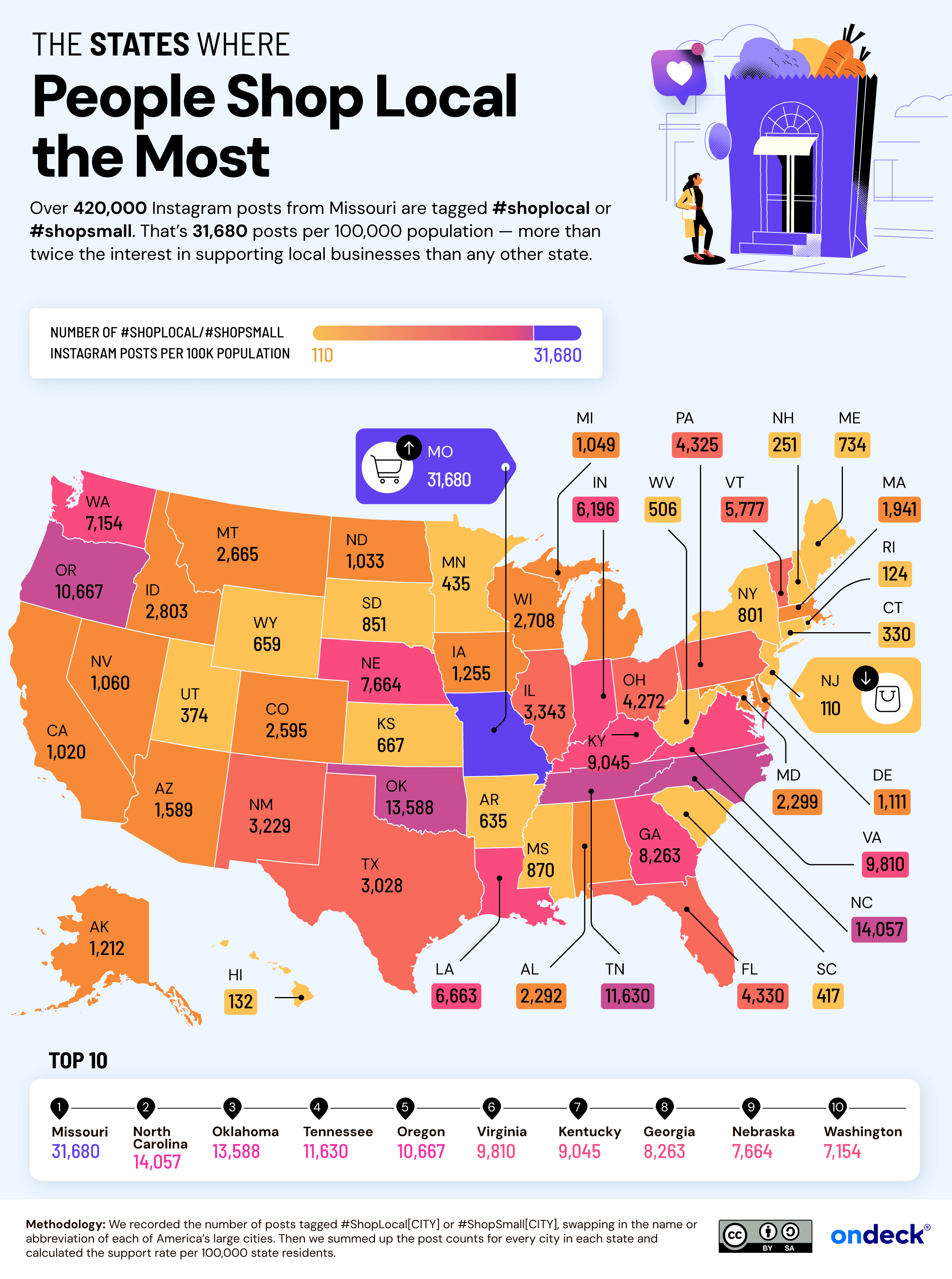
- There are 31,680 Instagram posts tagged #shoplocalMissouri or #shopsmallMissouri per 100k population, more than 2.25 times as many as any other state.
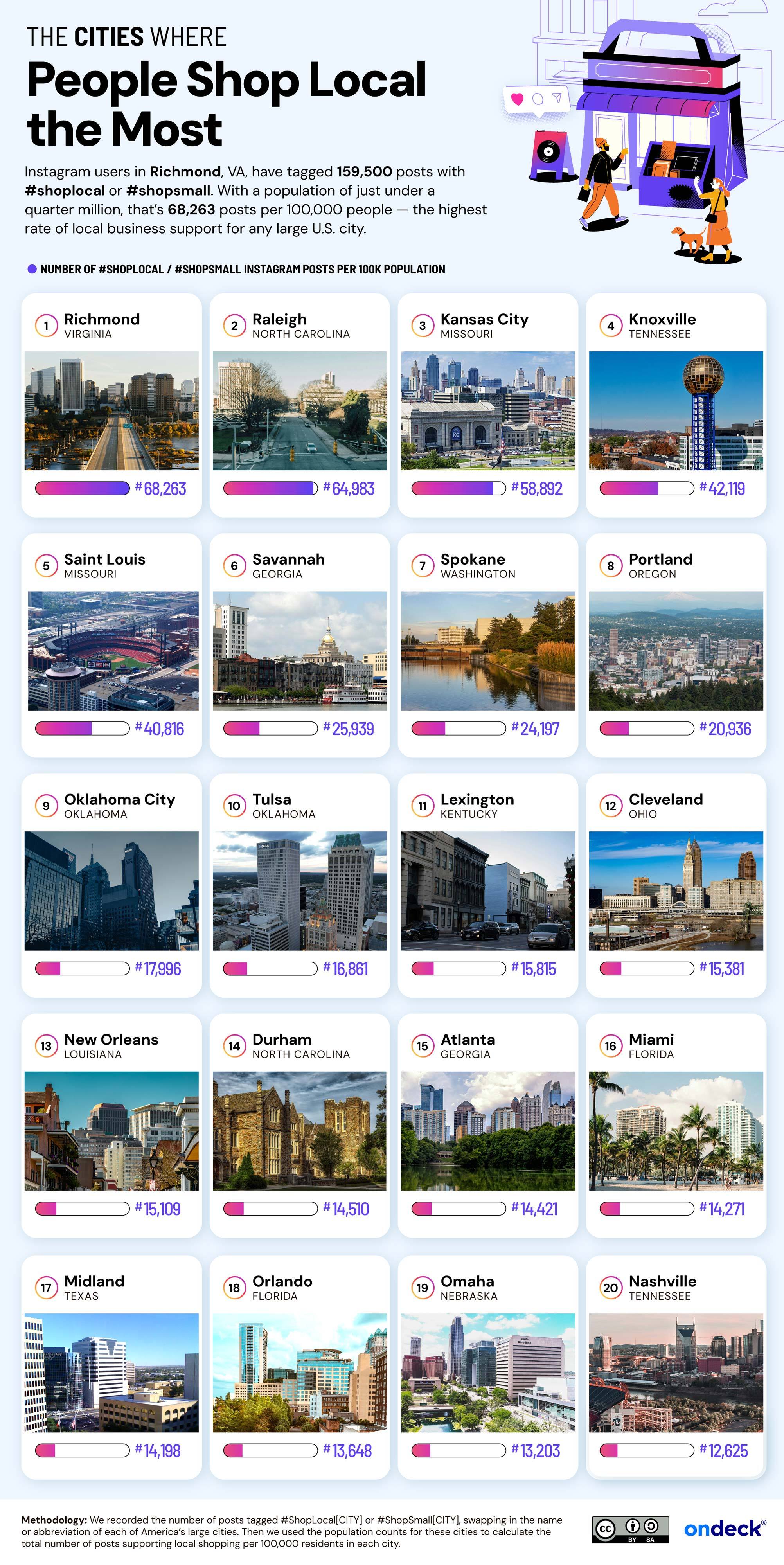
- Richmond, Va., is America’s Capital of #ShopLocal, with 68,263 posts per 100k population.
- New York (801 per 100k) and California (1,020 per 100K) are among the least enthusiastic states for shopping locally.
Missouri is the #ShopLocal state.
First, we counted the number of #ShopLocal[city name] and #ShopSmall[city name] Instagram posts for nearly 500 major American cities. We combined the count for each state and calculated the total per 100,000 state residents.
With 420,500 tagged posts and a 1.33 million state population, Missouri has the highest per capita rate of any state — 31,680 posts per 100,000 people. This is primarily thanks to 303,900 posts mentioning Missouri’s largest city, Kansas City, which is America’s third most #ShopLocal-positive city (see below). Saint Louis is also a big hitter.
Small businesses supply two-thirds of new jobs and drive 40% of America’s economic output, according to the SBA. And in Missouri, “employers that employ less than five people make up over 70% of all of our businesses in Missouri,” Dana Keller, executive director of the Mexico, Missouri Area Chamber of Commerce, told Missourinet in 2025.
Small businesses are “the ones that are boosting our economy,” continued Keller. “[W]hen you spend locally, you’re recirculating that money in your community. And I think that really helps support the things that we need, like our public safety, our infrastructure, those dollars stay local and close to home.”
Richmond, Va., is America’s capital of #ShopLocal.
America’s capital of #ShopLocal is Richmond, Va., which has been tagged 159,500 times. With a population of 233,655, that’s 68,263 posts per 100,000 people. That’s 5% more than second-placed Raleigh, N.C. (64,983) and more than Kansas City, Mo. (58,892).
“Small businesses, they’re about the connection,” RVA Black Farmers Market manager Navi Johnson told ABC 8News. “Supporting something other than the convenience of a bigger organization, being able to get something intentional, that is thoughtful, that still looks nice [and] that you can appreciate in the long run.”
Since 2021, Richmond has also benefited from the Shop Made in VA online store and retail location, which not only stocks and promotes local maker goods but also runs incubation and education programs for independent entrepreneurs. “Richmond is full of creative individuals,” says founder Stacey Price.
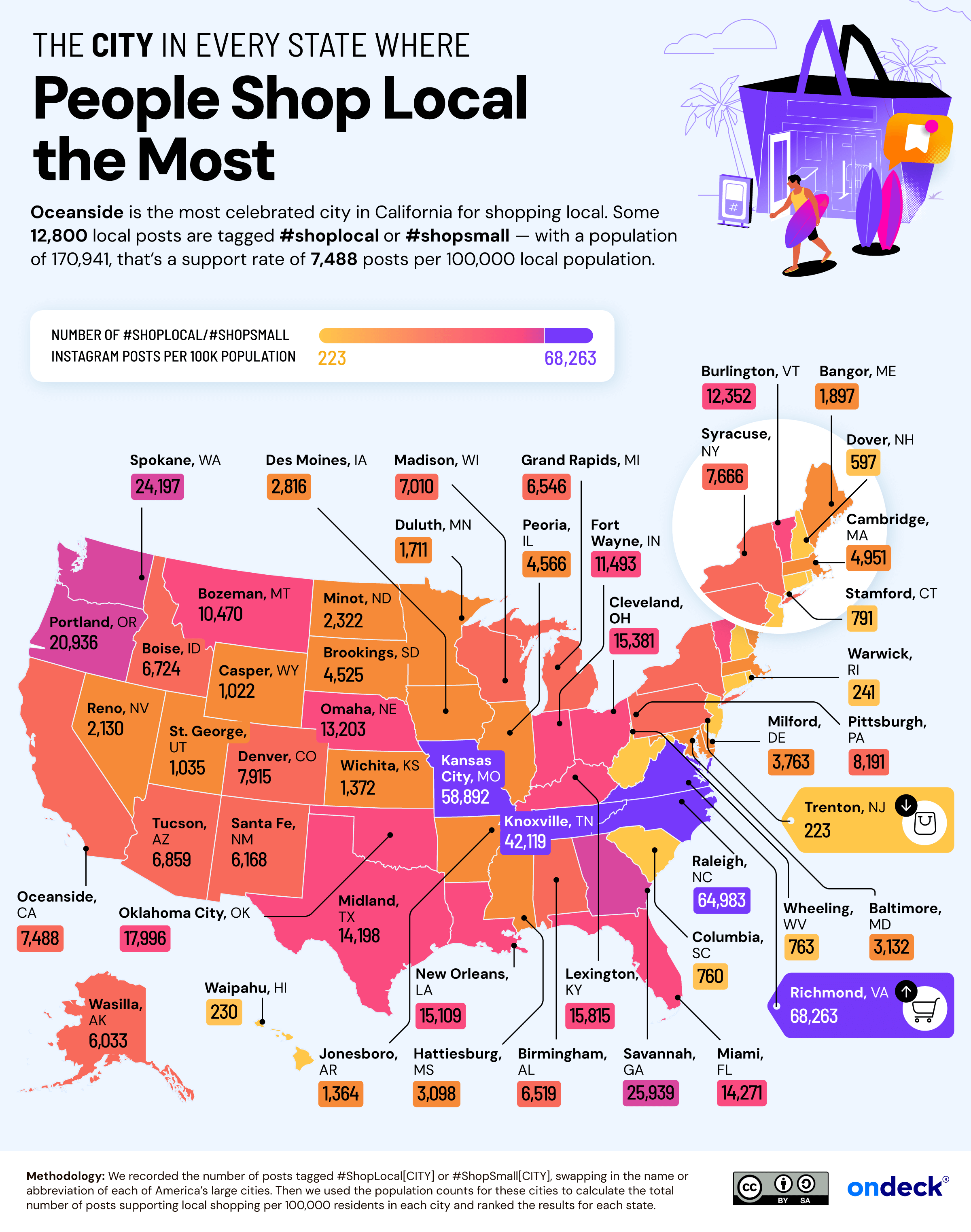
Finally, we identified the city with the most #shoplocal posts per 100,000 people in each state. It reveals the vast disparity in social media enthusiasm for supporting local small businesses from one region to another; in New Jersey, Hawaii and Rhode Island, there are just a couple of hundred such posts per 100,000, while the average for all states is 11,321 per 100,000.
How to promote your local business — and your neighbors — with Instagram.
Some 75% of 18-24-year-olds and 57% of 25-29-year-olds use Instagram. With its visual-first format and emphasis on commerce, Instagram is an ideal way to blend the desirable with the attainable, highlighting the familiar local environment of your businesses and creating community buzz through customer interaction and advocacy.
Here are some ways to generate interest in your small business and your local shopping scene when posting to Instagram.
Add your location. Create a link to a map of your premises by remembering to use the “Add location” function before you click Share.
Tag your location. Use hashtags for your neighborhood, city and state to reach a range of local audiences.
Collaborate with other local businesses. Help build a sense of community by posting in support of your neighbors (and encouraging them to do the same) or collaborating on competitions and giveaways.
Solicit user-generated content. Encourage your customers to share images of products or experiences they’ve bought from you, either tagging you in their own posts or submitting them for your marketing team to post.
Share local imagery. Put yourself on potential customers’ internal maps by sharing images that show where you’re positioned in the neighborhood.
As part of a dedicated social media marketing strategy, Instagram can be a fun and colorful way to build excitement around your brand and the local shopping experience.
Why shop local?
Shopping with locally-based businesses is healthy for your community’s economy and social life, as well as offering you a deeper relationship with the source of the products that you buy.
Keeps money in the local economy. The cash you spend goes to the business owner, their family and employees rather than shareholders or remote owners, and recirculates in the community.
Builds community identity. A neighborhood where the shops and services are created by local people may better reflect the uniqueness of the local cultural mix.
Encourages personal service. Local owners and their staff may be more engaged in their product and the customer service they provide, leading to more meaningful and satisfying relationships and transactions.
How to shop local
Streets lined with chain stores and search results that favor big corporations make shopping local more challenging than it should be. But with thought and care, it shouldn’t be hard to pay your dollar to local small businesses.
Think local first. When making everyday purchases, consider whether there’s a local and eco-friendly alternative to the obvious stores.
Get involved on social media. Join your neighborhood Facebook group, follow local stores and brands that you like and share positive experiences on Instagram, Facebook and TikTok.
Leave reviews and tell friends. Positive reviews can massively impact small businesses, enabling them to thrive and expand.
Can you shop local online?
Online marketplaces and small business websites make it possible to shop directly from the creator or local seller.
Shop with Etsy. Etsy is an online marketplace where millions of independent creators and sellers trade their unique products.
Order directly from local business websites. If you find a new product you like in a chain store or on Amazon, search for the product online to see if it’s possible to shop direct.
Include your locality in your search. Use your place name, “near me” or location filters when searching for products in search engines or social media apps.
Methodology
We created a seed list of the five largest U.S. cities by population in each state and of every city nationwide with a population of over 100,000. Then we recorded the number of Instagram posts tagged #shoplocal or #shopsmall for each city (i.e., #ShopLocal[CITY] or #ShopSmall[CITY]). For some cities, we used the city nickname or abbreviation (e.g., “ShopLocalOKC” for Oklahoma City) when it was the most common usage. Next we calculated the number of posts per city per 100,000 residents. To get a total per 100,000 people for states, we summed the post count for the cities within each state.
Data is correct as of December 2025.
DISCLAIMER: This content is for informational purposes only. OnDeck and its affiliates do not provide financial, legal, tax or accounting advice.


