
No cost. No impact to your credit.


In our age of hyper-convenience, online stores and corporate giants offer quick, affordable purchases for anything from groceries to sports apparel. But choosing to shop local can provide a number of benefits to both you and your local community.
“Shopping local” means buying from independently owned businesses and neighborhood stores instead of big corporate chains. Doing so benefits the neighborhood socially and keeps your dollar circulating between local businesses and families. And while events like Small Business Saturday, Women’s Small Business Month and Small Business Week bring attention to small businesses, it’s year-round support that helps keep them in business.
To better understand American attitudes toward shopping locally, small business lender OnDeck asked a representative group of 2,000 consumers, including members of three key generations, about why, when and how much they choose to shop locally, in partnership with the research consultancy Censuswide.
Key Findings: Shopping local statistics
- The average Millennial (age 29 – 44) makes 158 purchases from local businesses each year — more than any other generation.
- Millennials spend an annual average of $19,173 locally, which is 4.7 times as much as Baby Boomers (age 61 – 79) ($4,077).
- Survey participants estimate they spend 37% of their grocery budget locally — the highest proportion for any shopping category in this study.
- The average consumer surveyed plans to spend 11.9% more at local restaurants in 2026.
- The primary reason for shopping local is to “Help the local economy,” with 48.2% of survey respondents citing this among their reasons.
Millennials and Gen Z make 25% more purchases from independent stores than any other generation
First, we asked our survey respondents: On average, during a typical week, how many purchases do you make at independent stores (rather than chain stores) each week, if any?
The mean among all survey respondents is 2.46 purchases per week, or 128 annually. But this rises to 158 annually for Millennials (those aged 29 – 44 in 2026) and falls to just 48 annually for those aged 80 and over. The purchase rate of Generation Z, also known as “Zoomers”, (aged 18 – 28) is almost indistinguishable from that of Millennials, at 155 per year. This fits a broader trend of younger generations seeking more meaningful shopping experiences.
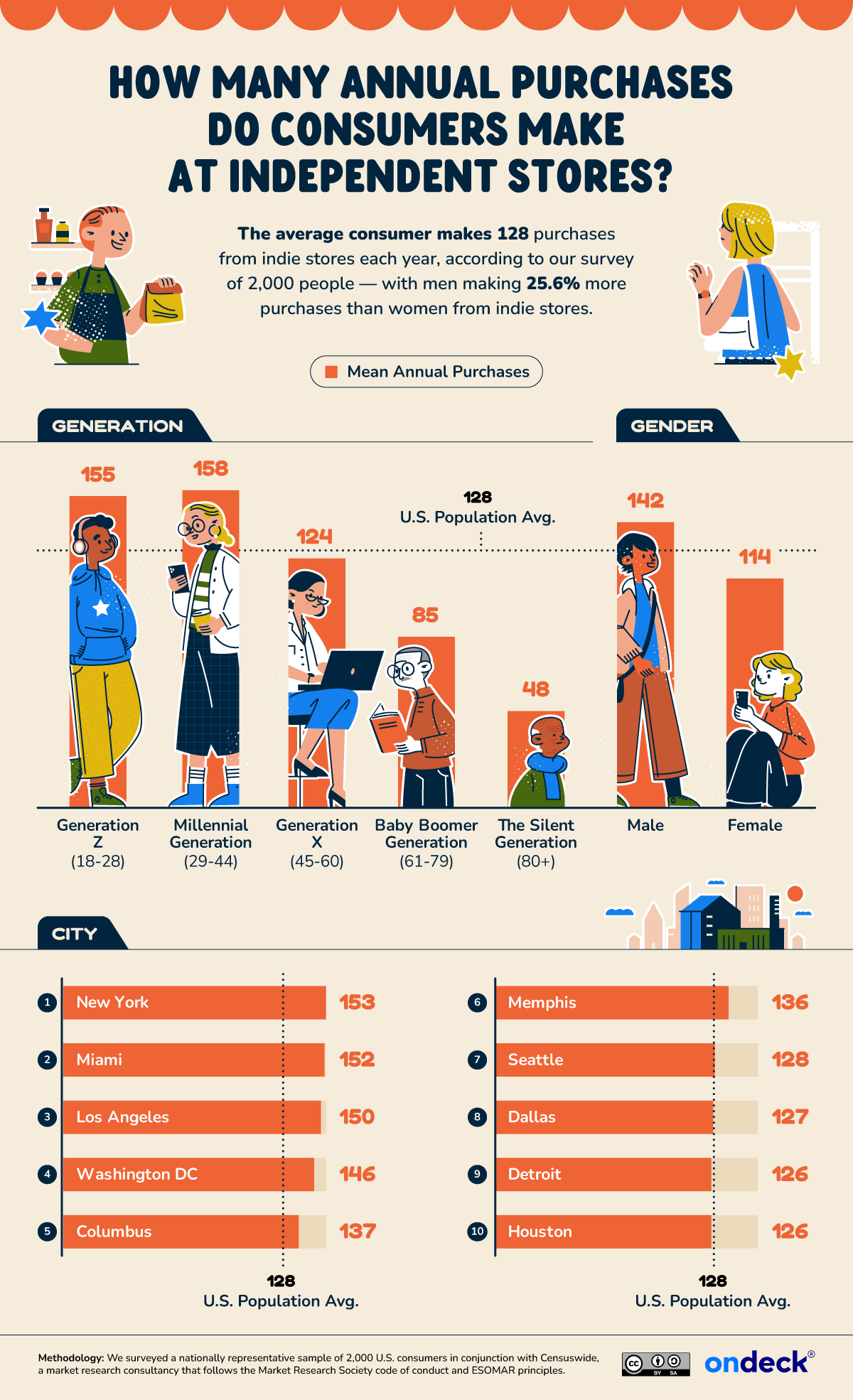
Men report making 142 local purchases each year, which is 24.56% more than women (114). Curiously, a 2024 study showed that men may be more susceptible to impulse buys, brand loyalty and being “influenced by influencers” — suggesting a nuanced emotional engagement with shopping habits and principles.
Across the country, people in New York (153 annual purchases), Miami (152) and Los Angeles (150) shop locally most frequently.
The average consumer spends $11,740 annually shopping locally
Next, we asked respondents to estimate how much they spend shopping locally each year. Annually, the average Millennial may only make three more purchases than the average Gen Z, but they estimate spending 18.05% more with local businesses than the younger generation. Regardless of generation, the average respondent claims to spend $11,740 annually shopping locally.
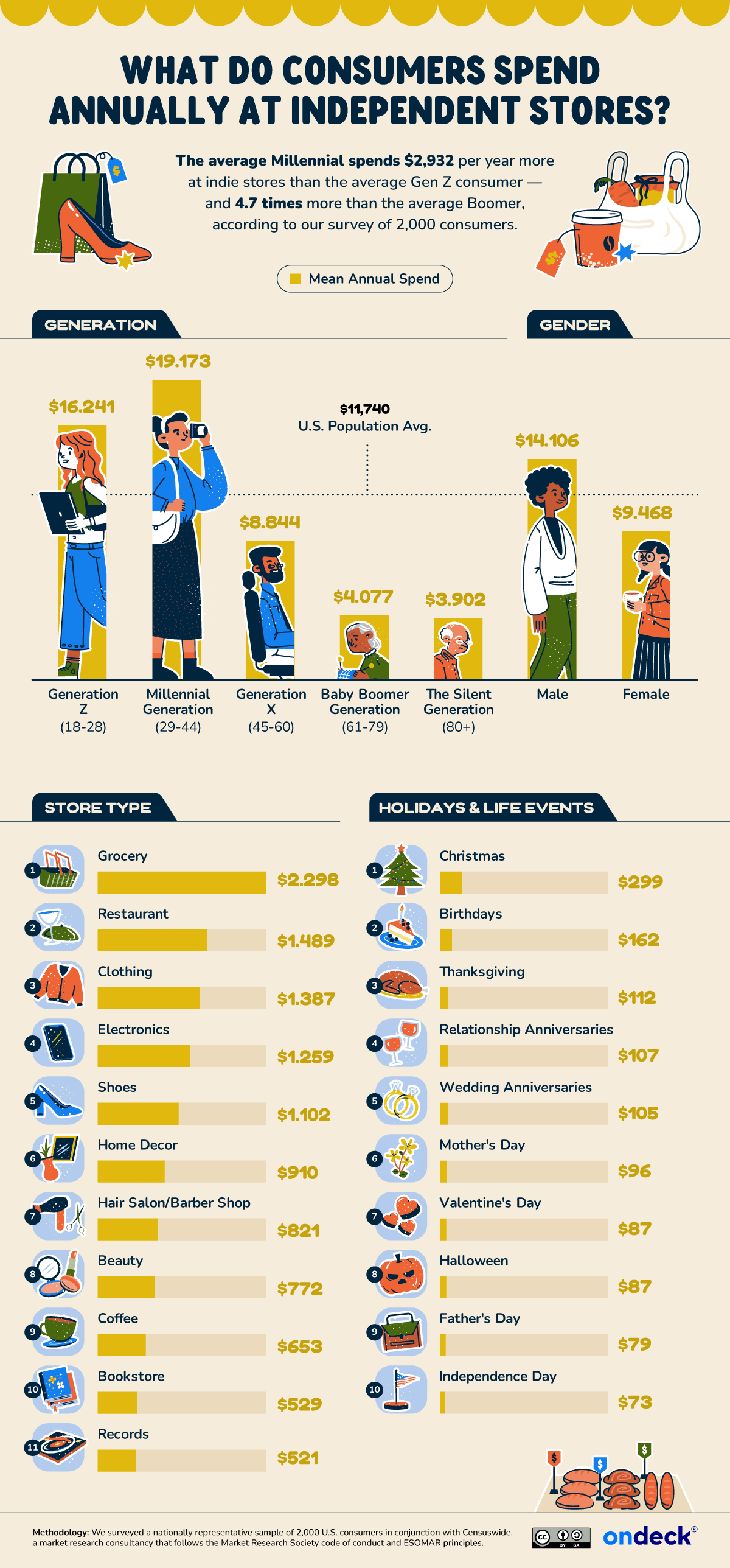
Surveyed participants are reportedly spending a smaller and smaller proportion of their income on groceries, but the local grocery store remains the top destination of the average shop-local dollar. Our survey suggests that the average consumer spends $2,298 on groceries from independent vendors annually, which is 1.5 times that of the second-largest category, restaurants ($1,489).
The event that drives the most spending at independent stores is Christmas, with the average respondent spending $299 locally. Consumers may make a bigger spend on Christmas than on birthdays annually to start with, but this higher spend may be easier to maintain at Christmas if they develop a shop local strategy for the season.
Indie bookstores receive just 13% of annual book spending
We built a list of shopping categories and calendar events and asked survey respondents what percentage of their spending in each category/event is at independent stores.
Grocery spending again came out on top, with consumers reporting that they spend an average of 37% of their grocery budget at local stores.
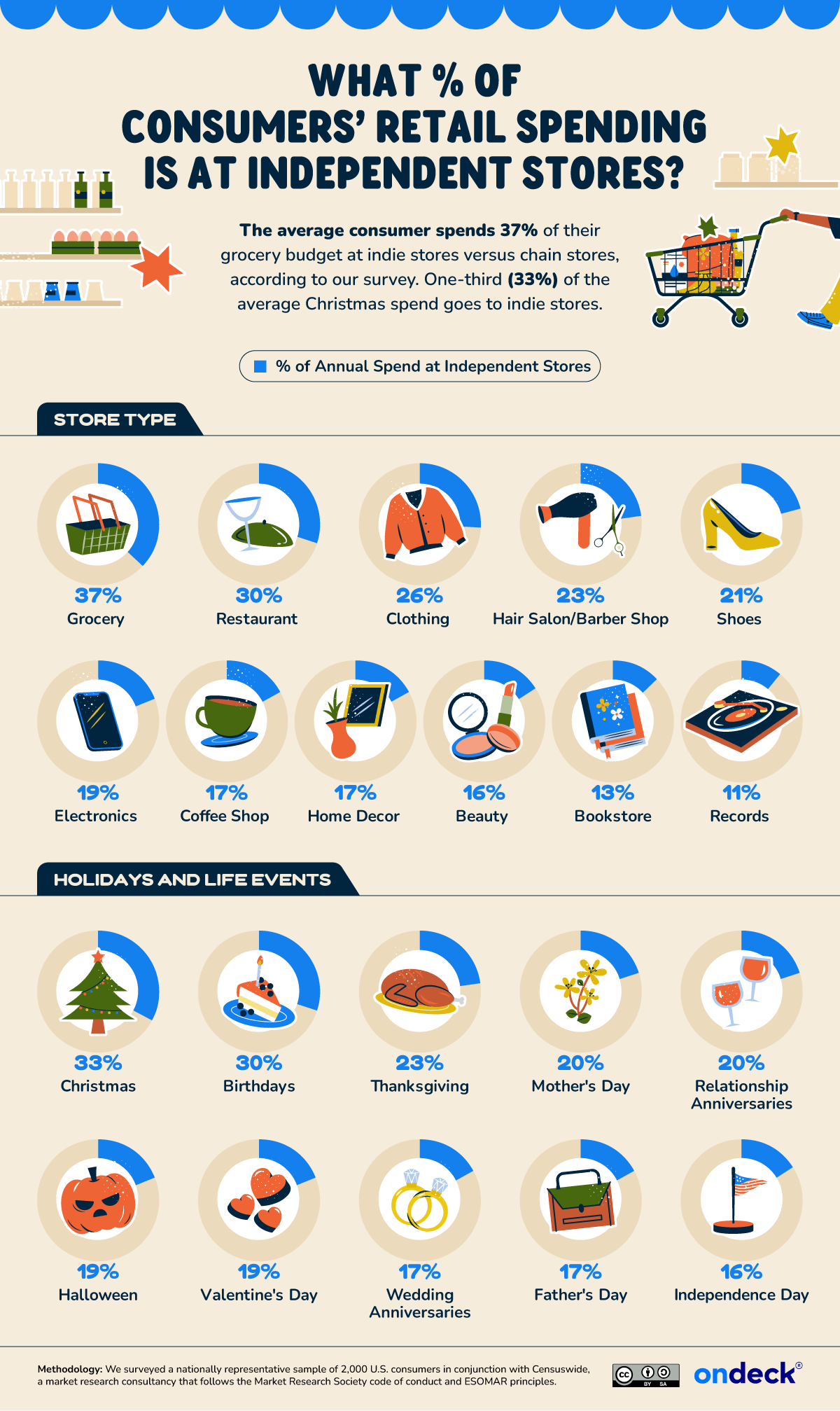
Bookstores remain the second-lowest category for independent shopping, whether measured by average dollars spent ($529) or percentage of consumers’ annual book-buying budget. Out of every $10 the average respondent spends on books, they report spending just $1.30 at independent bookstores. Yet, the American Bookseller Association reports that “29% of all revenue at independent bookstores immediately recirculates in the local economy” via “labor, profit, procurement, and charitable giving” — compared to just 5.8% when you buy at Amazon.
Still, when we asked how respondents thought their spending at independent stores for these holidays and life events will change in 2026 (below), book-buying locally remained a low priority, with an average intended spending increase of just 6.4%.
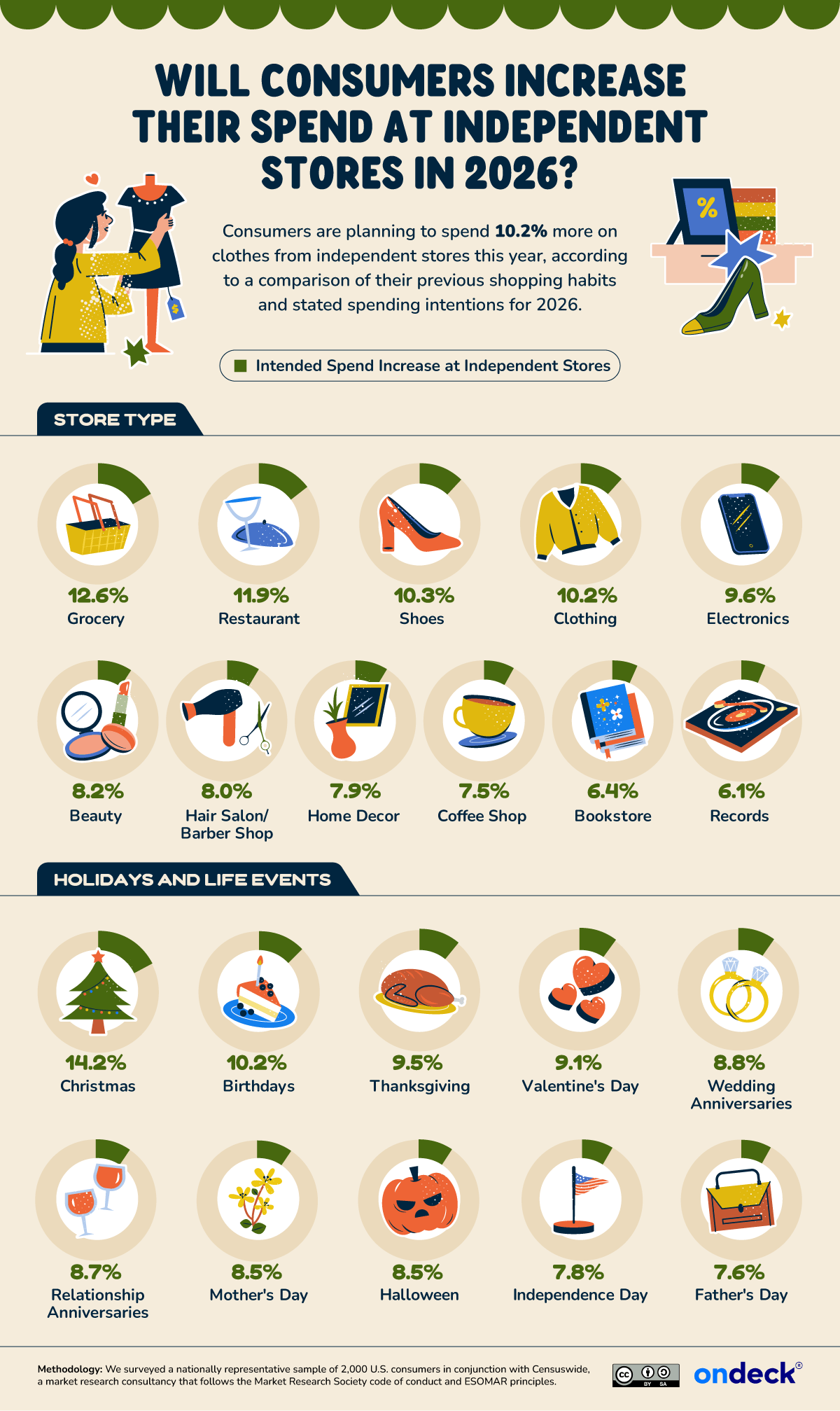
Likewise, consumer priorities for life events and public holidays remain similar in 2026. The average respondent’s biggest expected independent spending hike is for Christmas, the event that already garnered the highest proportion of money spent locally (32.6%) of any event and for which consumers intend to increase their local spending by 14.2% this year.
Consumers say they shop local to help the economy and access unique goods
Finally, we asked respondents to select up to five main reasons they want to shop independently from a list of ten.
The primary reason, by a significant extent, is to “Help the local economy,” with 48.2% of consumers listing this among their priorities. Research from the American Independent Business Alliance suggests that “small independent retailers return more than three times as much money per dollar of sales to the local economy than chain competitors,” according to Monica Haynes, director of the Bureau of Business and Economic Research. This leads to more revenue for local businesses, more jobs and bolstered local tax coffers.
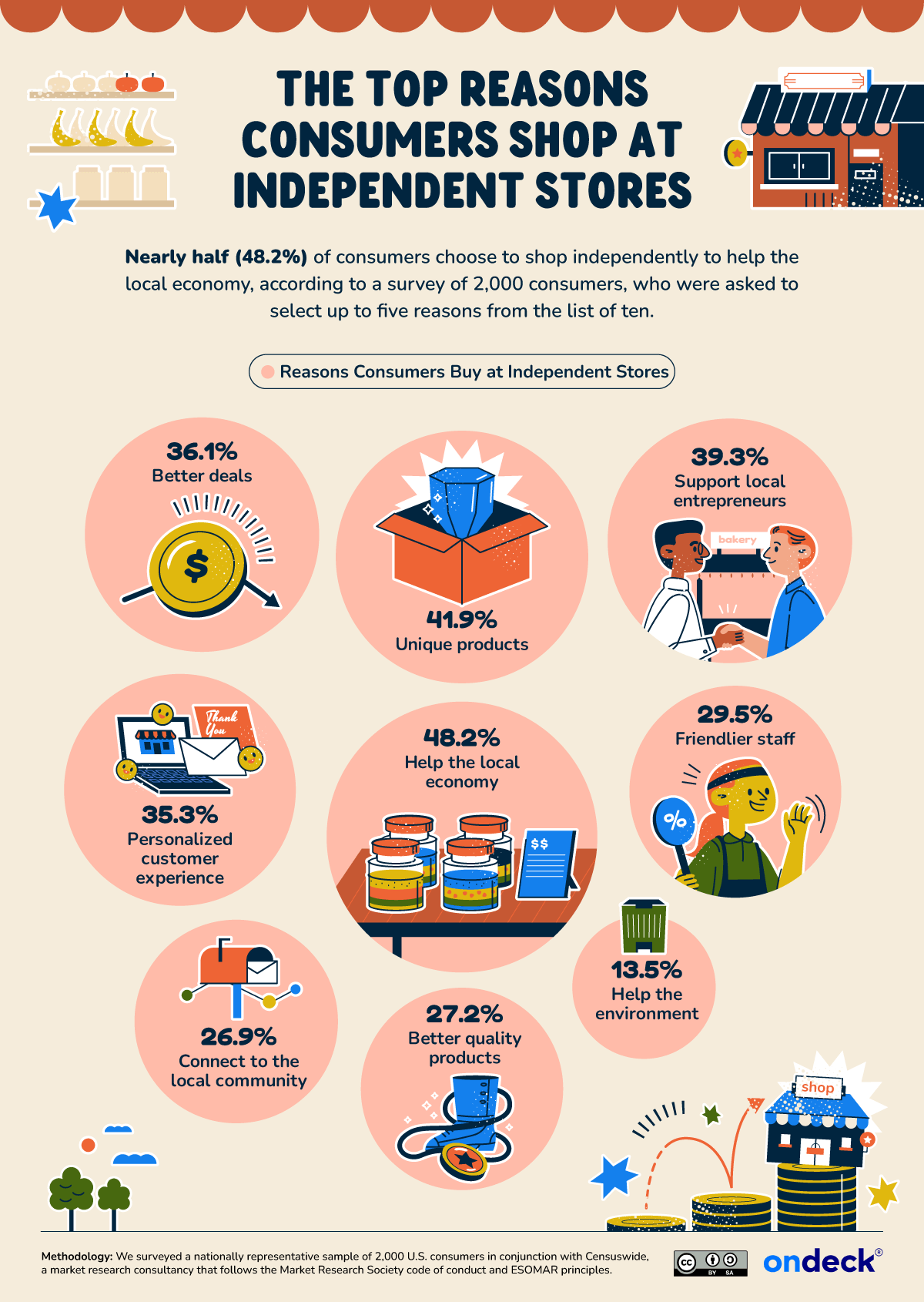
Other key reasons that survey participants shop local include the unique products (41.9%) and to support local entrepreneurs (39.3%). Perhaps surprisingly low among consumer priorities is the desire to help the environment by shopping local — although perhaps consumers aren’t aware how advantageous it is for environmental protection.
Just 13.5% list “Help the environment” among their reasons for shopping local, although the practice reduces transportation miles and fuel consumption, reduces the food and other waste associated with bigger retailers and helps keep local farms in business rather than being sold off for development.
How can you switch to shopping local?
Buying from smaller, independent businesses offers many economic, social and environmental advantages. It can also help you access more unique, personal and high-quality products. To start making the change to shopping local, consider these tips:
Leave a bit more time to shop. Quick online deliveries may save a lot of people from showing up to birthday parties empty-handed. Still, by planning out purchases a few more days or weeks in advance, you can open up more purchasing options for yourself.
Stay flexible. Part of the pleasure of buying from independent makers and retailers is the more human scale of production. So, if you can’t find what you set out to buy, consider waiting for new stock or selecting a different item rather than switching to a bigger retailer.
Engage with the community. Chat with local shopkeepers for tips and recommendations, and leave reviews and social media posts to support their business and a healthy local business environment.
Methodology
In conjunction with Censuswide, small business lender OnDeck surveyed a nationally representative sample of 2,000 U.S. residents (aged 18+).
Censuswide abides by and employs members of the Market Research Society and follows the MRS code of conduct and ESOMAR principles.
The data was collected between 12/11/2025 and 12/18/2025.
DISCLAIMER: This content is for informational purposes only. OnDeck and its affiliates do not provide financial, legal, tax or accounting advice.


