
No cost. No impact to your credit.


One of the most important decisions you make when starting a new small business is the location. Factors from local costs to broadband speeds and from customer demand to tax rates all impact massively on ensuring that your business is one of the 82% of start-ups that survive beyond their first year.
To help you find your way, online business lender OnDeck analyzed the conditions of nearly 10,000 large ZIP code areas as they relate to small businesses in the area — rating each with a score out of 100 based on the local variables that contribute to a new business’s health.
What We Did
We created a new small business index scoring system based on 13 local variables, including local small business wages and wage growth, tax rates, cost of living, density of working-age population and Business Broadband speed, to give each area a score out of 100 potential points. We then used this score to analyze and rate the conditions of nearly 10,000 large U.S. ZIP code areas as they relate to small businesses in the area. Here is what we found in the study.
(For full details on how we calculated the index score, please see the methodology at the end of the article.)
Key Findings
- The 07650 ZIP code in Palisades Park, N.J., ranks as the premier U.S location to start a small business, with a new small business index score of 72.58 out of 100.
- New York City’s best area for new small businesses is the 11201 ZIP code (Brooklyn Heights/Downtown Brooklyn/Dumbo) with a score of 69.77 out of 100 based on multiple factors.
- The best place in California to start a new business is the 94114 ZIP code area of Castro District/Eureka Valley in San Francisco, with a score of 67.52 out of 100.
New Jersey’s Palisades Park ZIP area ranks as a top-tier location for new small businesses.
First, we identified the overall ZIP codes that are best to start a new business.
America’s best ZIP code in this study for start-ups is 07650 in Palisades Park, New Jersey, which has a new business score of 72.58 out of 100 based on strong local business growth and revenues, a healthy workforce base and good broadband speeds, among other factors.
Palisades Park has America’s highest density of Korean-Americans, and this thriving community in itself encourages others to come and be a part of the area’s entrepreneurial success story. This growth has also enabled local authorities to reduce tax rates.
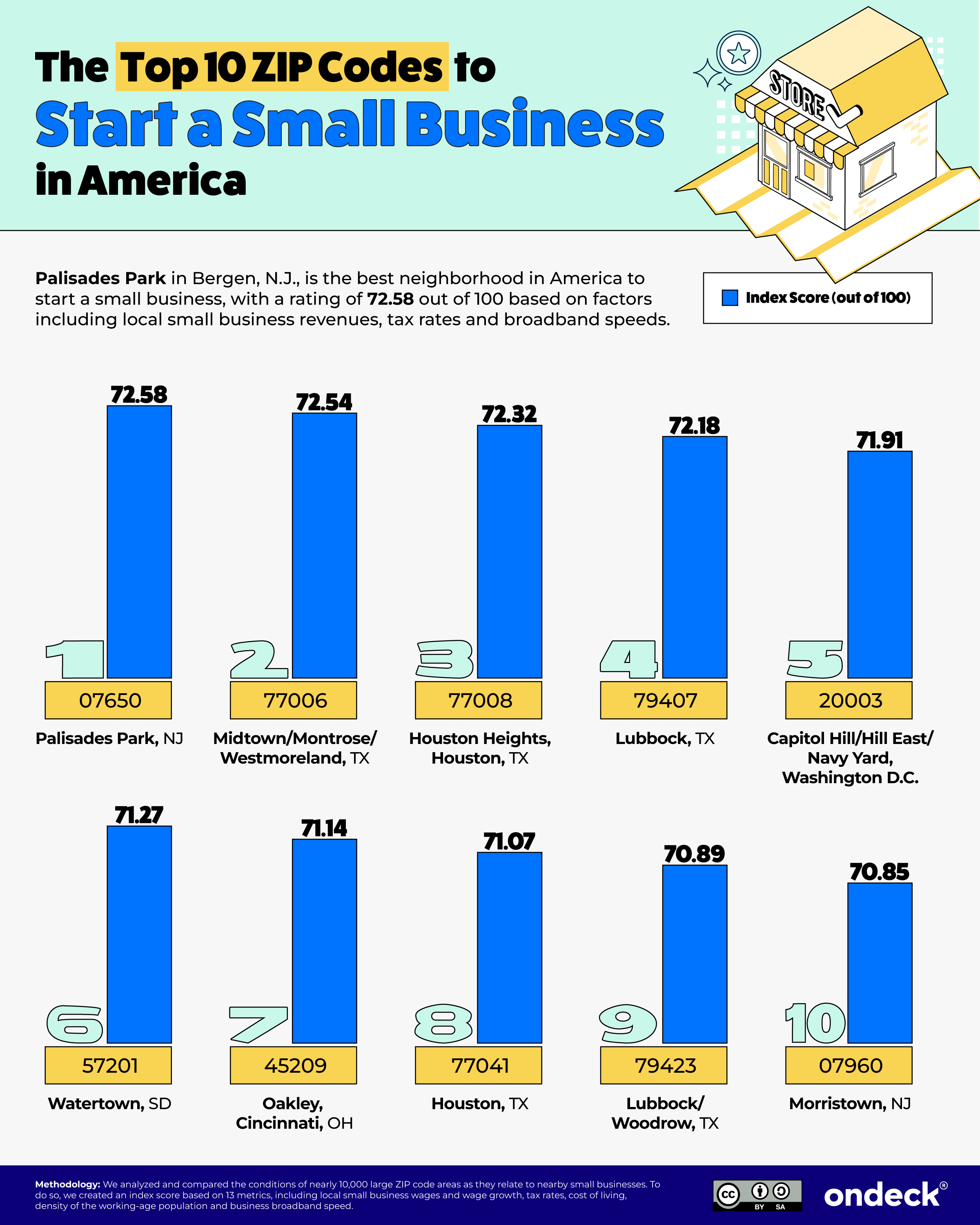
Five of the top 10 ZIP codes to start a new business are in Texas, including three in the Houston area of Harris County. Leading the way are Midtown/Montrose/Westmoreland (77006) and Houston Heights (77008) with 72.54 and 72.32 points on our startup generation index, respectively.
Houston is now America’s fourth-largest city and was the fastest-growing of the ten largest cities over the past decade. The city is wealthy, well-positioned as an international port and relatively tolerant and diverse among its neighbors. It is considered one of the country’s leading areas for digital innovation and entrepreneurship.
New York City’s new business hotspot is Brooklyn Heights/Downtown Brooklyn/Dumbo.
Next, we isolated the best ZIP code to start a small business in 15 major cities. While neither Boston nor L.A. has a ZIP code that scores over 60.0 on our startup index, Houston (see above) and Washington, D.C., both have ZIP codes that score over 70.
In the case of D.C., the top neighborhood is 20003 — the Capitol Hill/Hill East/Navy Yard area. It has a score of 71.91 out of 100 on our index. This ZIP code is one of D.C.’s wealthiest areas, with the median house price around $925,800. One study found that D.C. has one of the highest proportions of minority-owned businesses, including the highest percentage of African-American small business owners of any state.
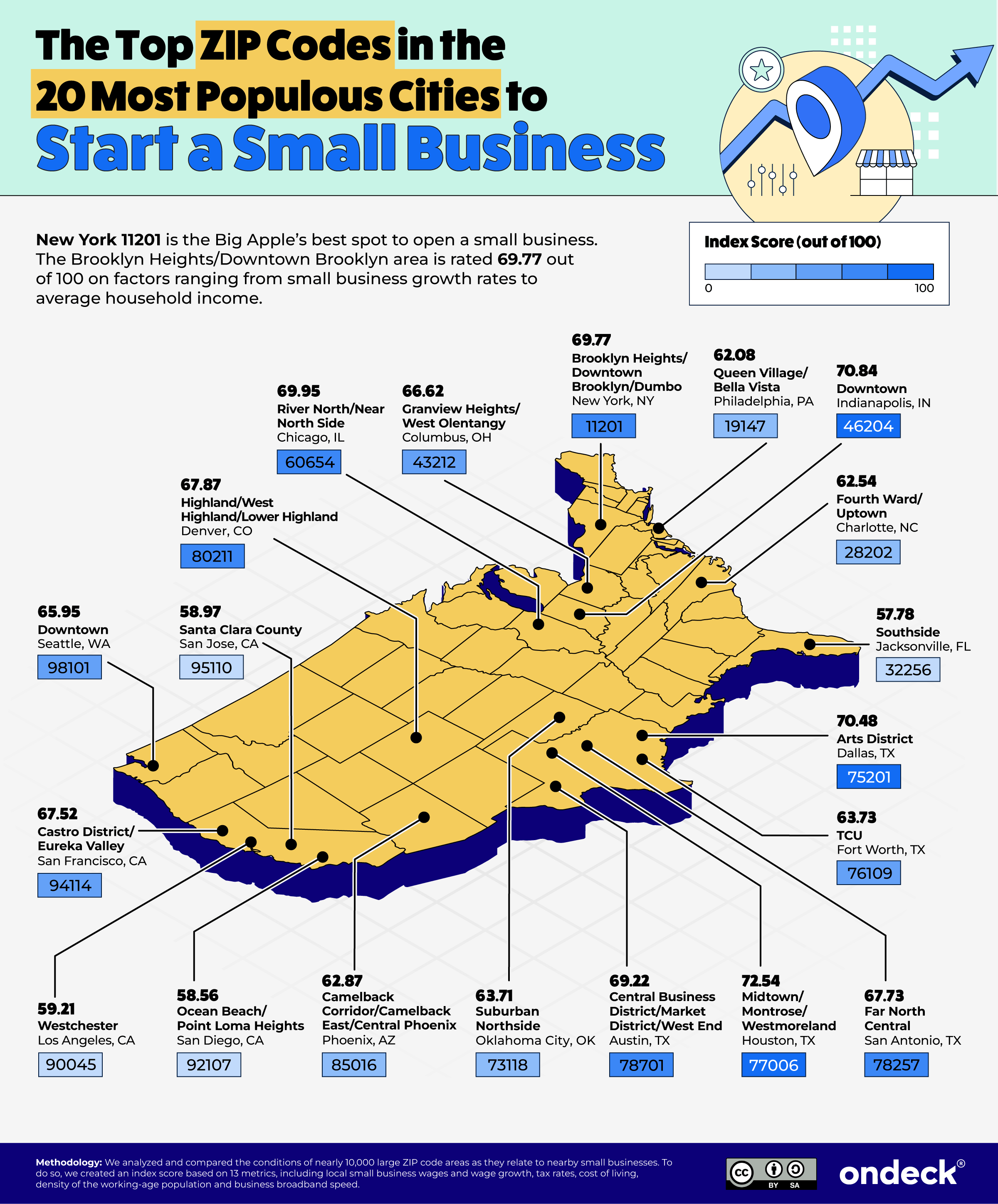
New York City’s top spot for new businesses is the 11201 ZIP code, covering Brooklyn Heights/Downtown Brooklyn/Dumbo, with a score of 69.77. It’s a complex picture as the area balances both the buzzing cultural powerhouse of the Downtown area and the more refined and affluent profile of Brooklyn Heights. Costs are high, and Montague Street alone lost dozens of storefront businesses during COVID — more than one-fifth of the high street.
Yet this and the area around it are leading the city’s recovery, with Dumbo among a handful of North Brooklyn neighborhoods that, between them, account for more new businesses over the past few years than the rest of the city combined.
Castro District in San Francisco is California’s best ZIP code for small businesses.
Finally, we highlighted the most amenable ZIP code for new small businesses in every state.
California’s 94114 ZIP code encompasses the Castro District/Eureka Valley areas of San Francisco and scores 67.52 in our small business index. Castro’s night market and other community events have helped the area regain “the buzz of pre-pandemic Castro once again,” according to Nate Bourg, president of the Castro Merchants Association.
However, San Francisco’s entrepreneurial heritage is undergoing a complex evolution, with older small businesses looking to city officials for protection against landlords who seek to oust them for more lucrative tenants — as has been the case in Castro.
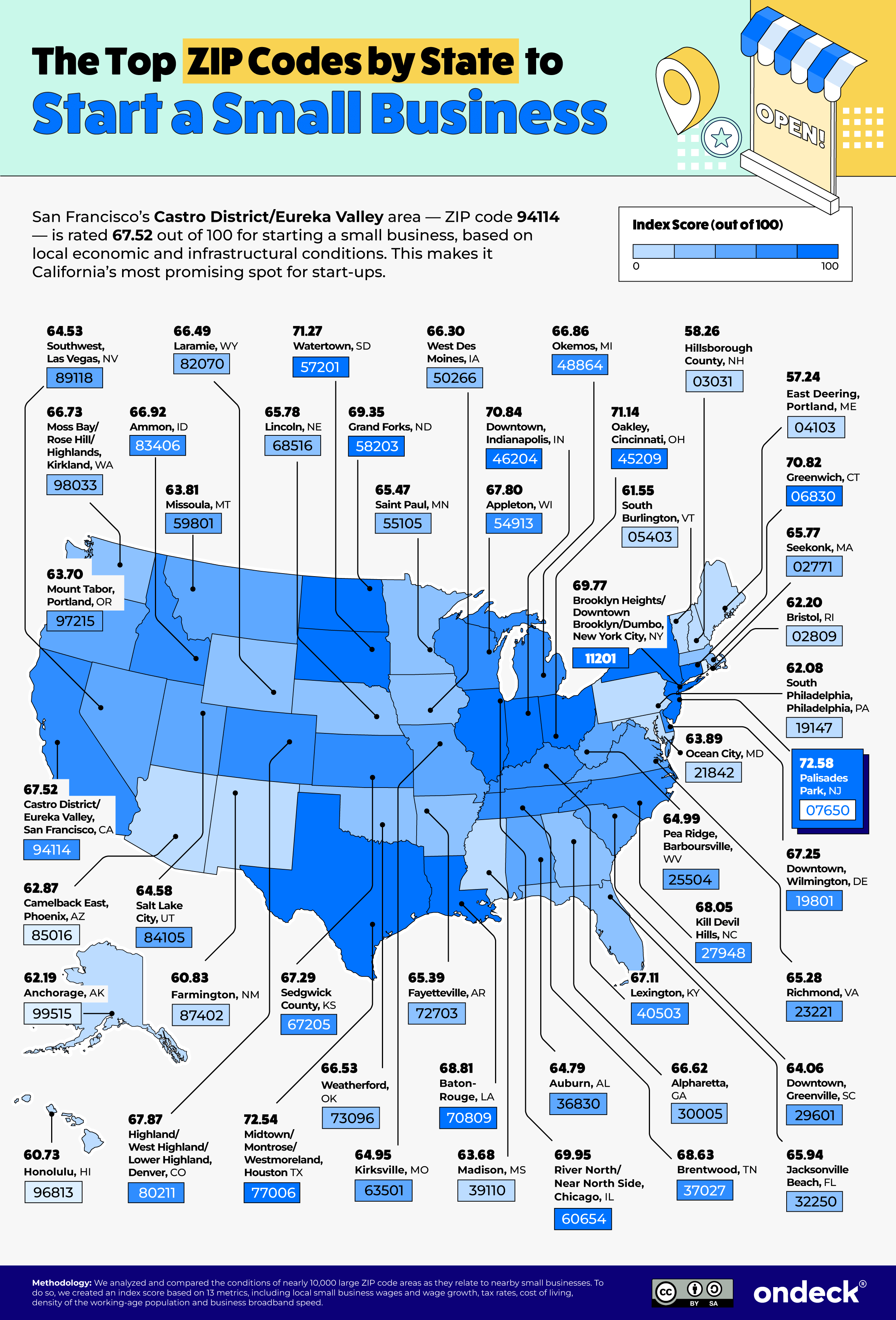
The 04103 ZIP code in East Deering, Portland, is Maine’s top area for new businesses, although it only scores 57.24. Tough wage conditions counter the area’s more positive aspects, such as labor availability and the sheer number of firms. But Northeastern University’s Roux Institute is establishing a new campus, including a business and startup incubation space in the area’s former B&M Baked Beans factory, with a $25 million road improvement scheme in place to keep the area competitive.
“These institutions have and can develop a class of future community leaders trained in the arts, medicine, law, public policy, education, business and hard science research,” says Portland Mayor Mark Dion. “We need that emerging talent pool to move forward.”
How to choose a location for your small business.
Choosing your business location is one of the most important decisions when starting up. Consider these points as you do your research.
Is there local demand? Figure out the clientele you need, where they are and whether they’re already catered to in that area. If you’ll have a storefront, is it in a position to attract passers-by, or will you need to find ways to generate foot traffic?
What are the local start-up costs? Different states and municipalities charge different sums for their services. Make sure to factor in registering your business, meeting tax obligations and obtaining licenses and permits when assessing a location.
How are salary levels and labor availability? You’ll want to attract the best staff to your business, but that comes at a cost in higher wage areas or where a smaller workforce means making more competitive offers to secure labor.
Is it conveniently positioned? Consider the transport links and parking for customers and suppliers. You may need to make frequent visits to your premises, including outside of regular working hours. How long will your journey be?
Is the community supportive? Finding a friendly and welcoming community of customers and fellow small business owners can make all the difference when establishing your business, building a marketing buzz and solving problems that arise.
Methodology
We ranked 9,747 ZIP codes with populations over 10,000 across 13 small-business metrics and weighted the results to create an overall index score.
The 13 metrics we analyzed are as follows, with sources in parentheses and weightings in brackets.
- Average wage at small businesses (U.S. Census) [1.5 ]
- Percentage growth in average wage at small businesses (U.S. Census) [0.5]
- Percentage wage difference between small businesses and all companies (U.S. Census) [1]
- Corporate taxes, calculated as the corporate tax expected for a 10% profit over the average small business income. (Taxfoundation, U.S. Census) [1]
- Cost of Living for one adult (MIT) [1]
- Number of small businesses per 1K residents (U.S. Census) [1.5]
- Percentage growth in small businesses (U.S. Census) [1]
- Number of small business employees per 1K residents (U.S. Census) [0.5]
- Average revenue of small businesses (U.S. Census) [1]
- Percentage of working age population (U.S. Census) [1]
- Average household income (U.S. Census) [1]
- Percentage of population working at small vs. big companies (U.S. census) [0.5]
- Business Broadband speed (FCC) [0.5]
As per the Small Business Administration, a small business was defined as one with an employee count below 500 people.
ZIP codes were ranked for each metric and assigned a score based on their percentile relative to the top-scoring ZIP code. The individual metrics were then weighted using the factors listed above.
For states without a corporate tax, we assumed a zero rate at all profit/income levels (a zero corporate tax rate gave the maximum score for the category). Other scores were multiplied by 0.9 to account for the base difference. Broadband speed represents the 250 / 25 – % business coverage for any terrestrial lines.
Data is correct as of February 2026.
DISCLAIMER: This content is for informational purposes only. OnDeck and its affiliates do not provide financial, legal, tax or accounting advice.


