
No cost. No impact to your credit.


A college degree is far from obligatory for those who aspire to own a business. Big companies like Microsoft (Bill Gates), Canva (Melanie Perkins) and Stripe (John and Patrick Collison) have thrived despite their founders dropping out of college before completing their studies.
And these are just some of the biggest names. Across the U.S., around two-fifths of everyday business owners operate without a college degree, according to Census Bureau data analyzed by business lender OnDeck.
What we did
We analyzed Annual Business Survey data from census.gov, categorizing business owners by education level attained, overall and by industry. When calculating the percentage of business owners without a college degree, we have grouped those who self-reported as less than high school graduates, those who graduated from high school (diploma or GED), those who attended trade (technical or vocational) school and those who went to college but didn’t complete their degree.
Key findings: What industries don’t require a college degree?
- 39.5% of U.S. business owners have no college degree, according to data from the U.S. Census Bureau.
- Two-thirds (67%) of construction business owners have no college degree — the highest number of any sector.
- Health and Social Care business owners are the most likely to have a college degree. Only 8% have no degree and 77% have a degree beyond bachelor’s level.
Construction industry boasts the highest percentage of owners without a college degree.
First, we calculated the percentage of business owners without a college degree in each industry, as indicated by the Annual Business Survey data from census.gov. While the overall percentage of U.S. business owners without a degree is 39.5%, we identified eight industries in which more than half of businesses fall into this category.
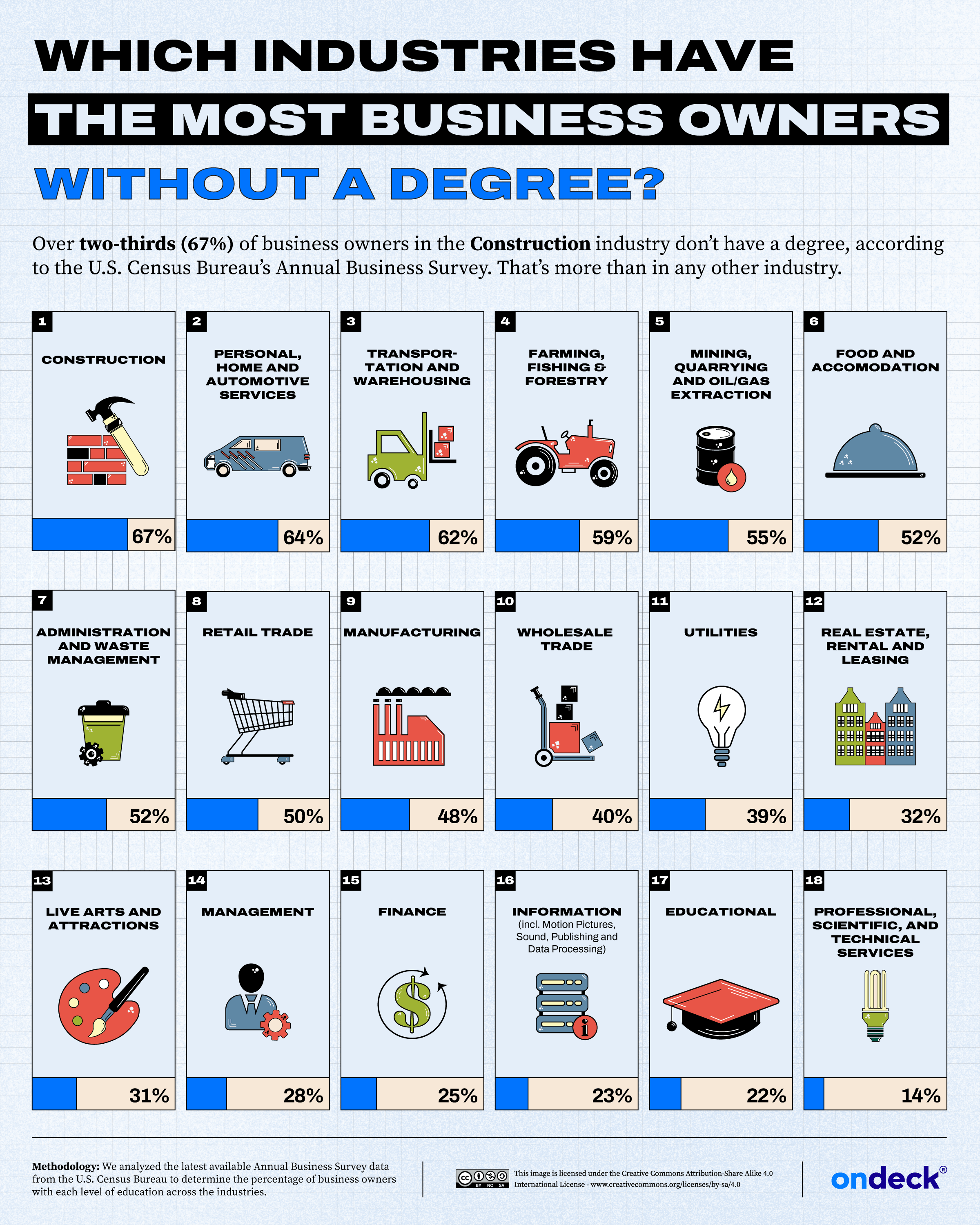
The three industries with the highest proportion of owners without a college degree are Construction (67%), Personal, Home and Automotive Services (64%) and Transportation and Warehousing (62%).
Farming, Fishing & Forestry has most business leaders who left education with a high school diploma.
Next, we broke down education-level data in more detail to see which qualification levels are most and least common among entrepreneurs in each industry.
In construction — the industry where business owners are least likely to have a college degree — nearly one-third (31.6%) of owners have a high school diploma or equivalent as their highest qualification, while 4.9% did not graduate from high school.
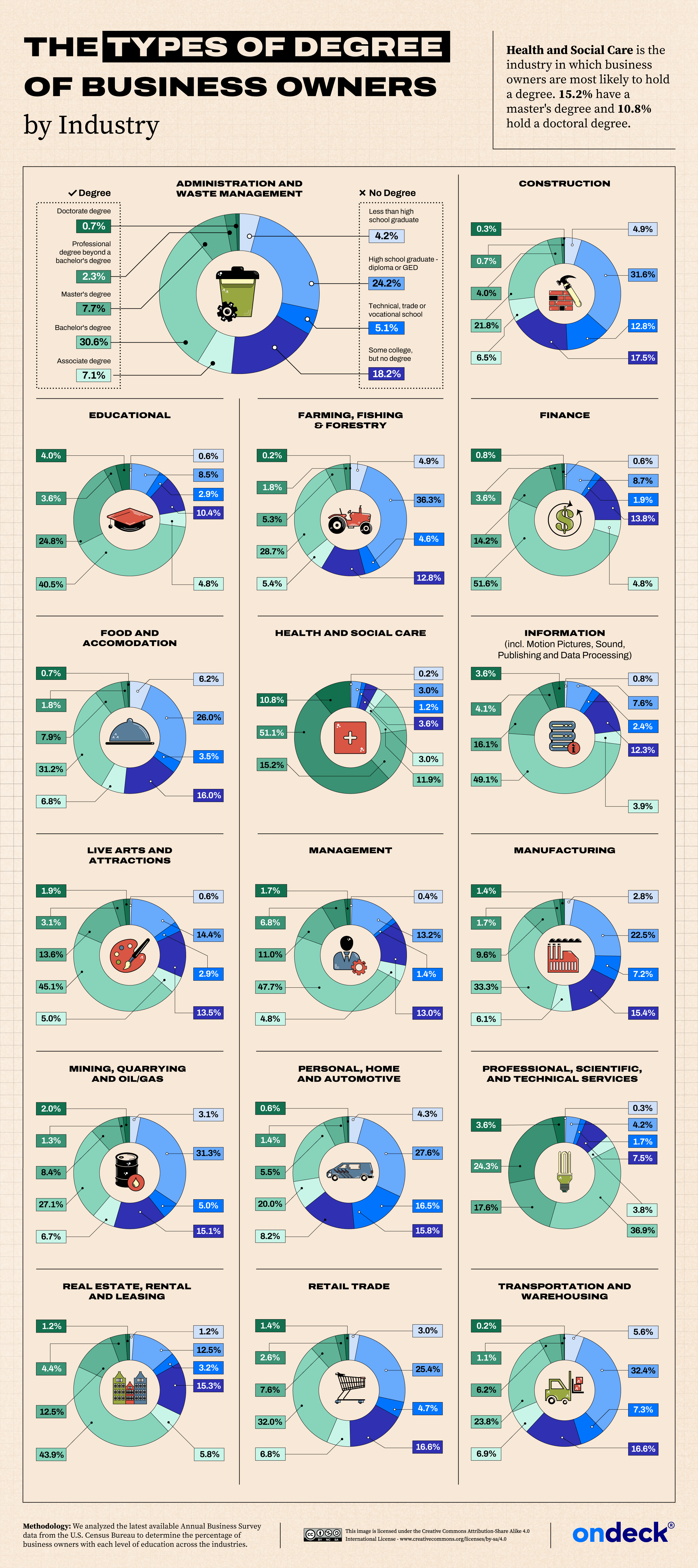
The Farming, Fishing & Forestry industry actually skews lower than this. In this industry, the same proportion (4.9%) do not complete high school, but 36.3% leave education with a high school diploma and no further qualifications. However, 41% of owners in Farming, Fishing & Forestry have a degree of some kind, which is nearly one-quarter more than in the construction industry.
Almost two in five U.S. business owners don’t have a college degree.
Our analysis of Census Bureau data shows that the most common level of certification among business owners without a college degree is a high school diploma or GED (18.1%). A further one in eight (13.3%) business owners attended college for a period without graduating.
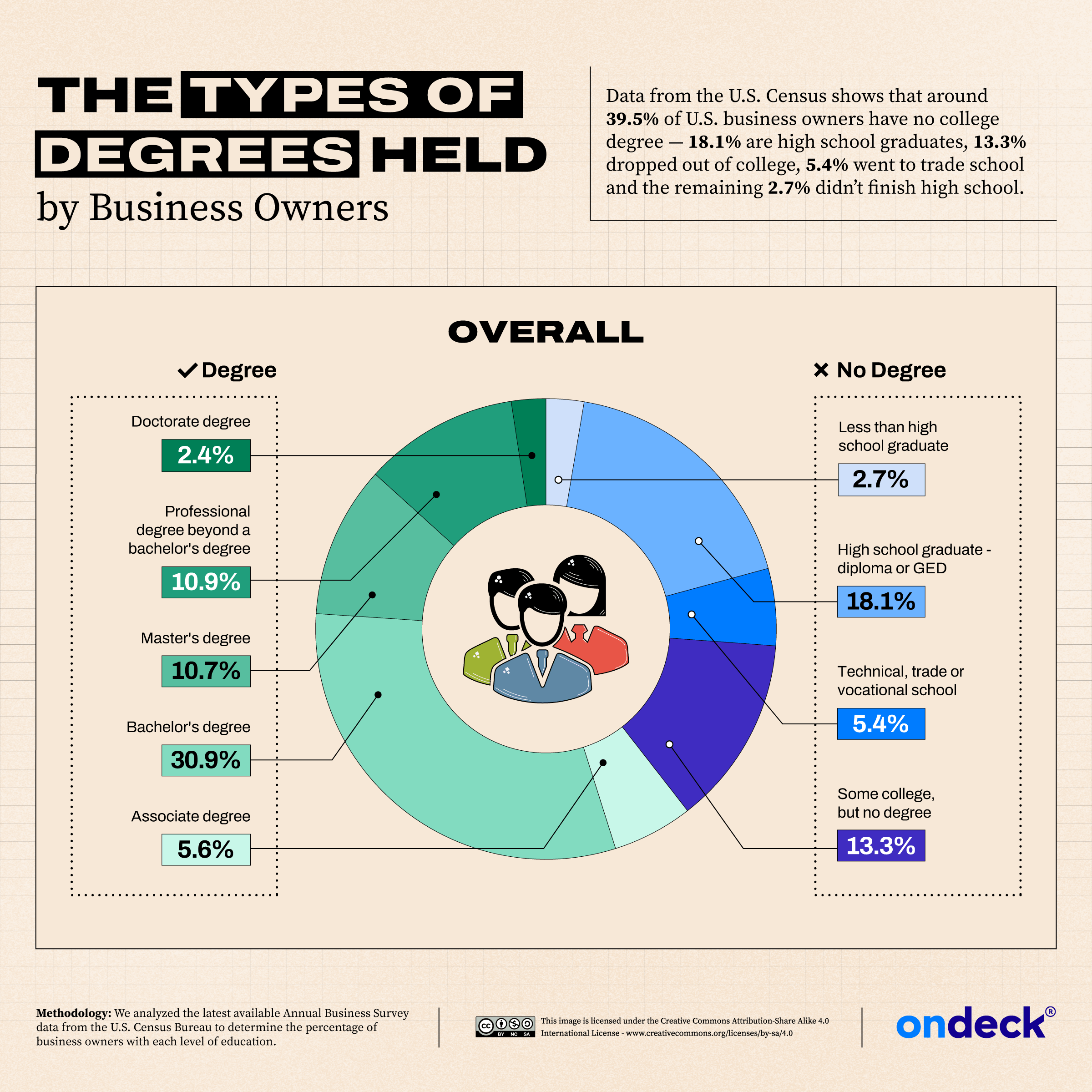
The most common education level among U.S. business owners is a bachelor’s degree. Some 30.9% of business owners have a bachelor’s as their highest educational attainment. Just over one in 10 business owners left education with a master’s degree, and one in ten finished with a post-graduate professional degree.
How to become a business owner without acquiring a college degree.
Most industries require no particular degree qualification if you want to start a business, although some business types in sectors such as healthcare, law and engineering do have qualification or license requirements.
To start a business, then, the bare essentials include an idea, funding, strategy and the know-how to manage day-to-day business needs — particularly if starting out alone without a business manager. Here are some ways to boost your chances of success.
1. Learn when and where you can.
Apple founder Steve Jobs famously dropped out of college to save money, because, in his words, “I had no idea what I wanted to do with my life and no idea how college was going to help me figure it out.” All the same, he continued to attend classes that interested him. Today’s entrepreneurs have a wealth of instruction at their fingertips through online courses and resources as well as traditional libraries and evening classes.
2. Build your network elsewhere.
A college degree provides not just learning but a cohort of up-and-coming professionals who may offer support and opportunities later on. Whether you attend college or not, you will benefit by meeting people in your industry at conferences and seminars, online, or by reaching out to relevant contacts such as former teachers or family friends.
3. Get ground-level experience.
If you want to know an industry, start at its grassroots. Figuring out how things really function at the level of an industry’s coding, factory floor, warehouses or store transactions can help you identify lucrative opportunities and practical solutions.
4. Optimize the experience and qualifications you have.
If you don’t want to do college, look at what you have learned both at school and in the jobs you’ve worked. How might you translate these skills and understandings into running your own small business?
Methodology
To produce this report, we analyzed the latest available Annual Business Survey data from the U.S. Census Bureau as of July 2026 in order to determine the educational level of business owners overall and by industry.
When tallying the figures, the following survey responses were grouped under the ‘no college degree’ umbrella:
- Less than high school graduate
- High school graduate (diploma or GED)
- Technical, trade, or vocational school
- Some college, but no degree
DISCLAIMER: This content is for informational purposes only. OnDeck and its affiliates do not provide financial, legal, tax or accounting advice.


