
No cost. No impact to your credit.


Companies with fewer than 500 employees have created 51% of new jobs since 2020, according to the U.S. Bureau of Labor Statistics, and now account for 45.9% of private employment in America. Women are starting new businesses at a higher rate than ever, and government figures suggest ethnic minority entrepreneurs are “driving America’s start-up boom,” according to The Economist.
But if new businesses are a sign of confidence, then confidence varies significantly from one part of the country to another — as OnDeck’s new study into the number of new small businesses in each state, county and metropolitan area demonstrates.
What we did
We analyzed the latest available Statistics of U.S. Businesses data from the U.S. Census Bureau across states, metropolitan areas and counties to identify the places across America with the highest percentage growth in small businesses (<500 employees) by comparing the last two years available. We also compared these figures against the previous year’s growth, which was obtained by the same method.
Key findings: The places in the U.S. where small businesses are thriving
- The number of new businesses in Nevada has grown 3.83% year-on-year — the biggest increase of any state.
- Fresno, California, is the large metropolitan area with the greatest year-on-year growth in new businesses (16.8%).
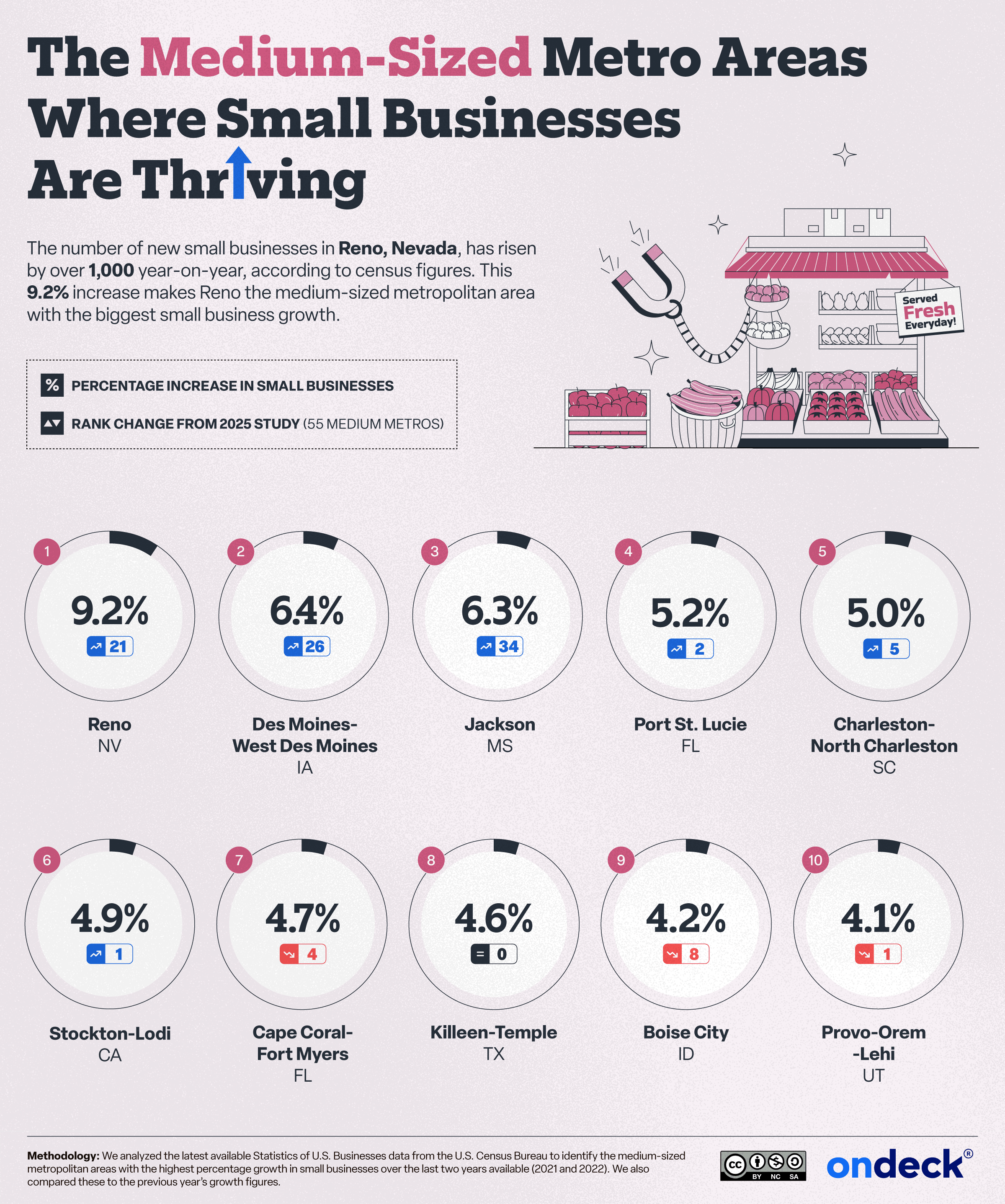
- The medium metro area with the fastest growth is Reno, Nevada (9.2%).
- The number of small businesses in the small metro area of Lexington Park, Marlyand, nearly doubled (96.0% increase) between the last two years with available Census Bureau data (2021 and 2022).
- Sheridan, Wyoming, is the county with the largest year-on-year growth in new businesses (18.9%).
Nevada is the state with the most new small businesses, proportionally.
First, we looked at the rise in the number of small businesses in each state across the latest two years for which Census Bureau data is available (2021 and 2022).
We found that the number of businesses with under 500 employees rose fastest in Nevada, where the increase from 56,912 to 59,092 represents a 3.83% change. Nevada had been the state with the fourth-fastest small-business growth the previous year.
The state that has climbed the charts most dramatically is New Jersey. A net increase of 3,089 small businesses, or 1.61%, has pushed New Jersey up 29 spots in the ranking to 17th position.
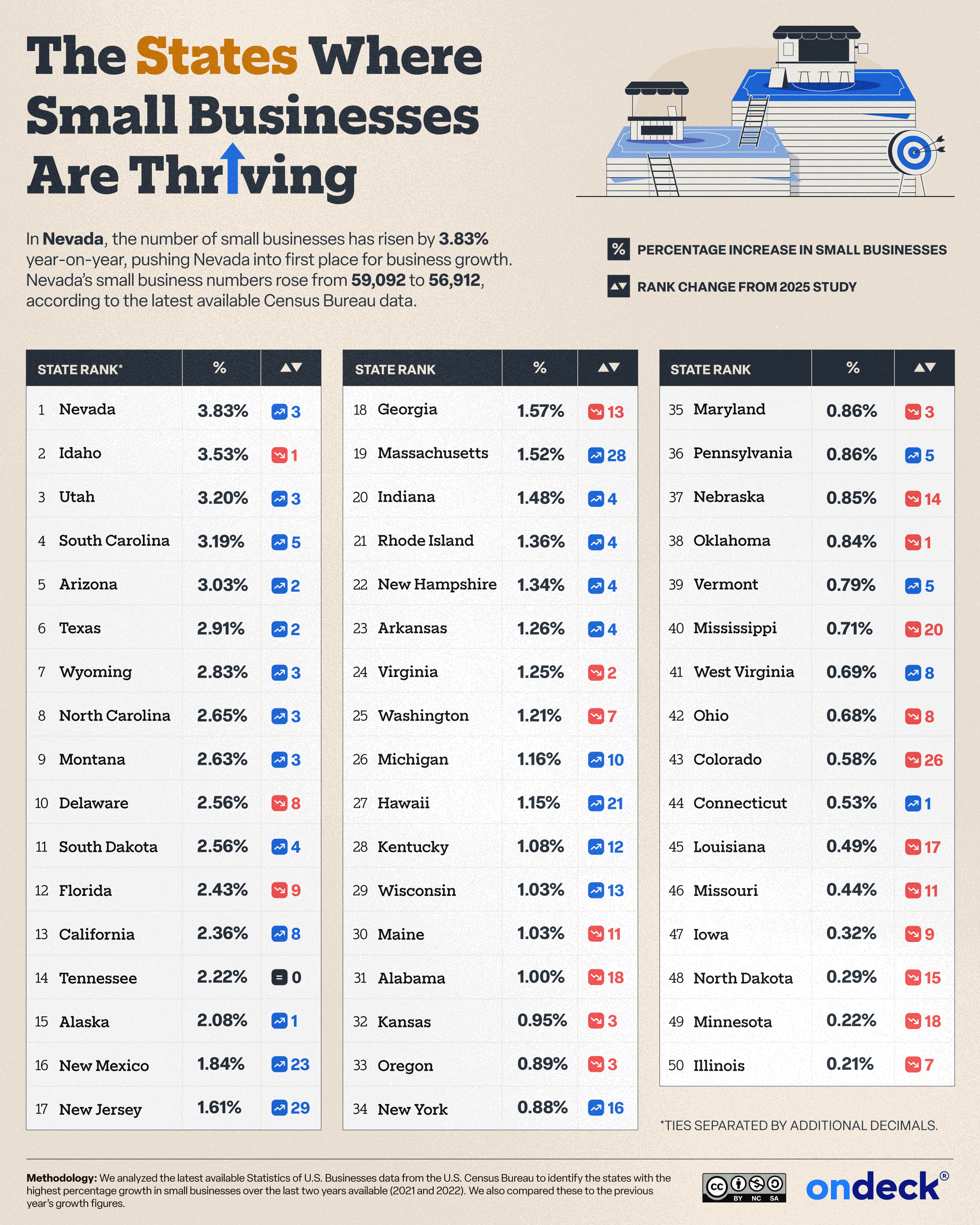
Every state saw a net increase in small businesses during our study period, but with a rise of just 0.21%, Illinois saw the slowest growth. However, Illinois does remain the state with the fifth-highest number of small businesses overall — a figure that currently sits at 253,302 firms.
Fresno, California, sees 16.8% rise in small businesses.
Next, we analyzed the data at the metropolitan area level, beginning with large metro areas.
With a 16.8% increase in small businesses between 2021 and 2022, the fastest-growing small business landscape in this category by a significant leap is Fresno, California. A net increase of 2,441 small businesses in Fresno across the years in question represents a 16.8% rise. This is 2.9 times the increase of second-placed Riverside-San Bernardino-Ontario, California (5.8%).
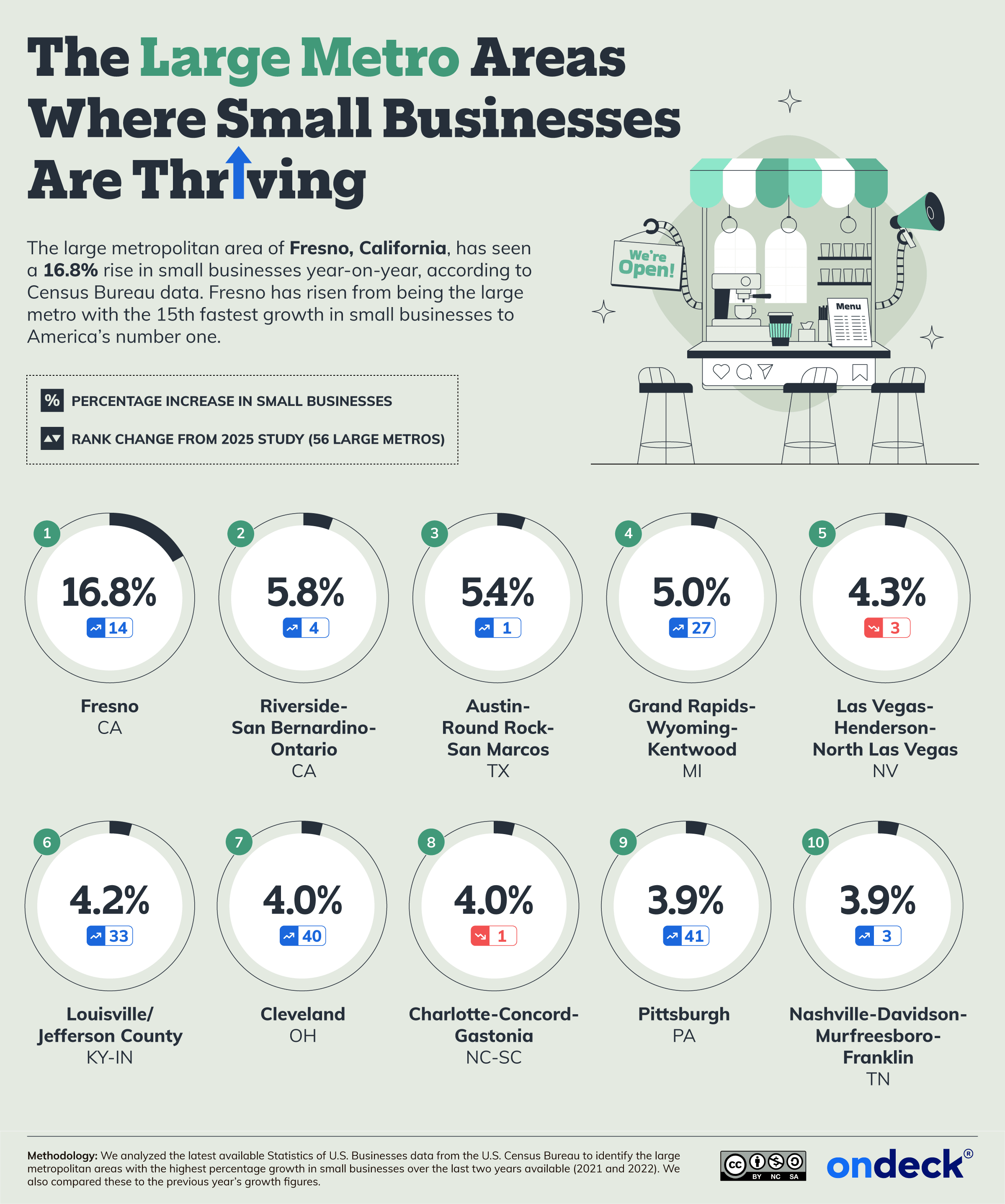
Among the 56 large metros with available data, the one that has climbed the table the fastest is Cleveland, Ohio, which rose 40 places into seventh position thanks to a 4.0% increase in small business numbers.
We also identified seven large metros with declining small business numbers, led by Hartford-West Hartford-East Hartford, Connecticut, which saw a -2.94% net decline in small businesses across the years in focus.
Reno is the medium-sized metro with the fastest-growing small business numbers.
Next, we looked at medium-sized metro areas. We found that Reno, Nevada, is the fastest-growing area for small businesses, with a 9.2% net increase in the number of small businesses between 2021 and 2022. This increase — representing an additional 1,002 businesses — sees Reno climb 21 places from the previous year’s ranking.
The cities with the second- and third-fastest-growing small business numbers climbed even further. Des Moines-West Des Moines, Iowa (6.4% increase) and Jackson, Mississippi (6.3%) rose 26 and 34 spots, respectively, in the ranking.
Two medium metro areas — New Orleans-Metairie, Lousiana (-21.91%) and New Haven, Connecticut (-28.26%) — had thousands fewer small businesses in 2022 compared to 2021. In the case of New Haven, the number fell by 4,329, from 15,320 to 10,991.
Small business numbers in Lexington Park, Maryland, nearly doubled year-on-year.
The ten small metropolitan areas with the fastest growth in new small businesses have all risen dozens or even hundreds of places up the ranking since last year.
These are led by Lexington Park, Maryland, which had 3,018 small businesses in 2022 — a net increase of 1,478, representing a 96.0% year-on-year rise. The previous year, Lexington Park was ranked 141st for new small businesses; according to the latest figures, it is now ranked first.
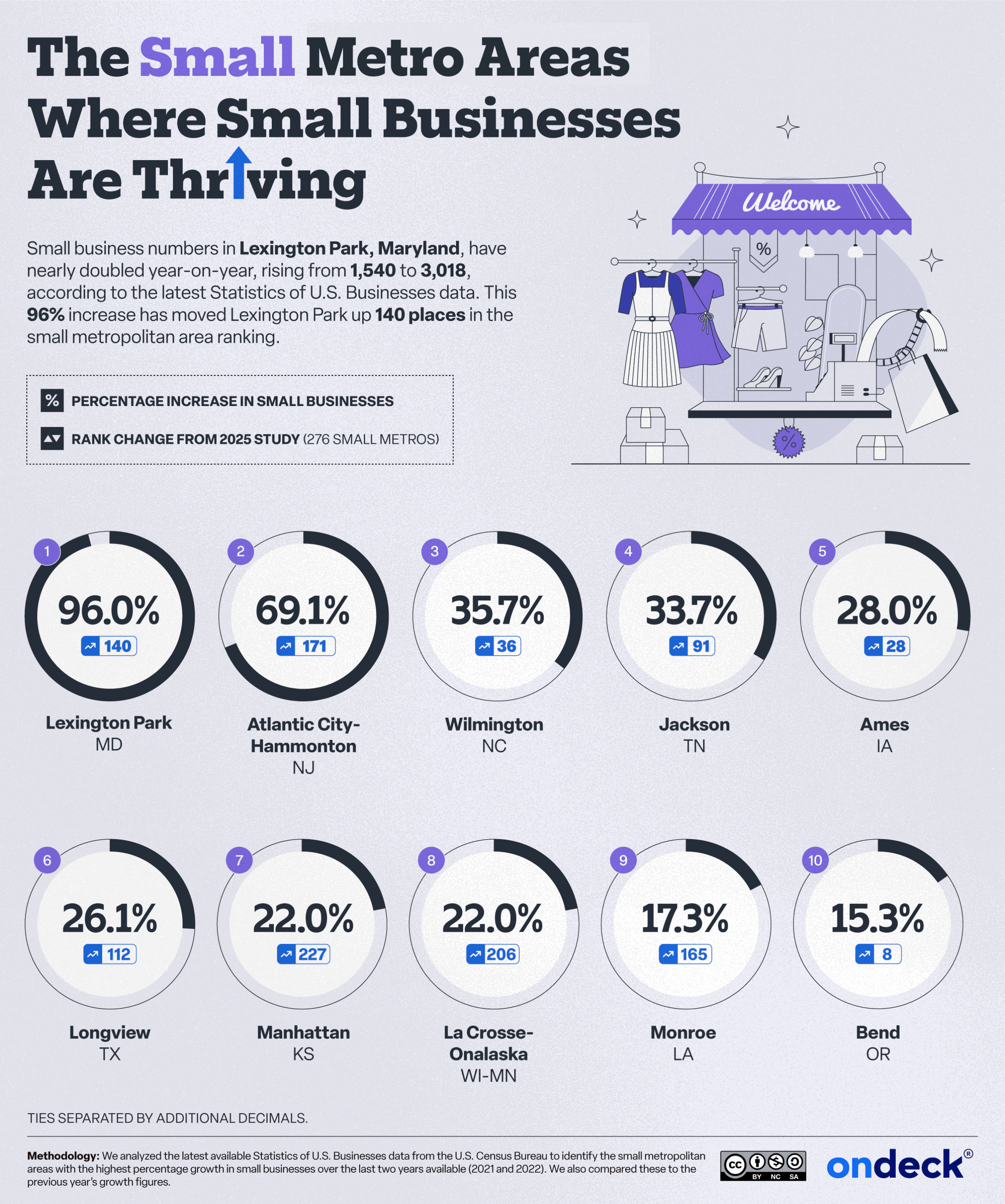
The biggest riser is Manhattan, Kansas, which rose 227 places up the rankings thanks to a 22.0% increase in small businesses.
Sheridan, Wyoming, is the county with the fastest-growing small business numbers.
Finally, we analyzed small business numbers at the county level, first ranking the 20 counties with the greatest new small business growth overall, and then mapping the top county in each state.
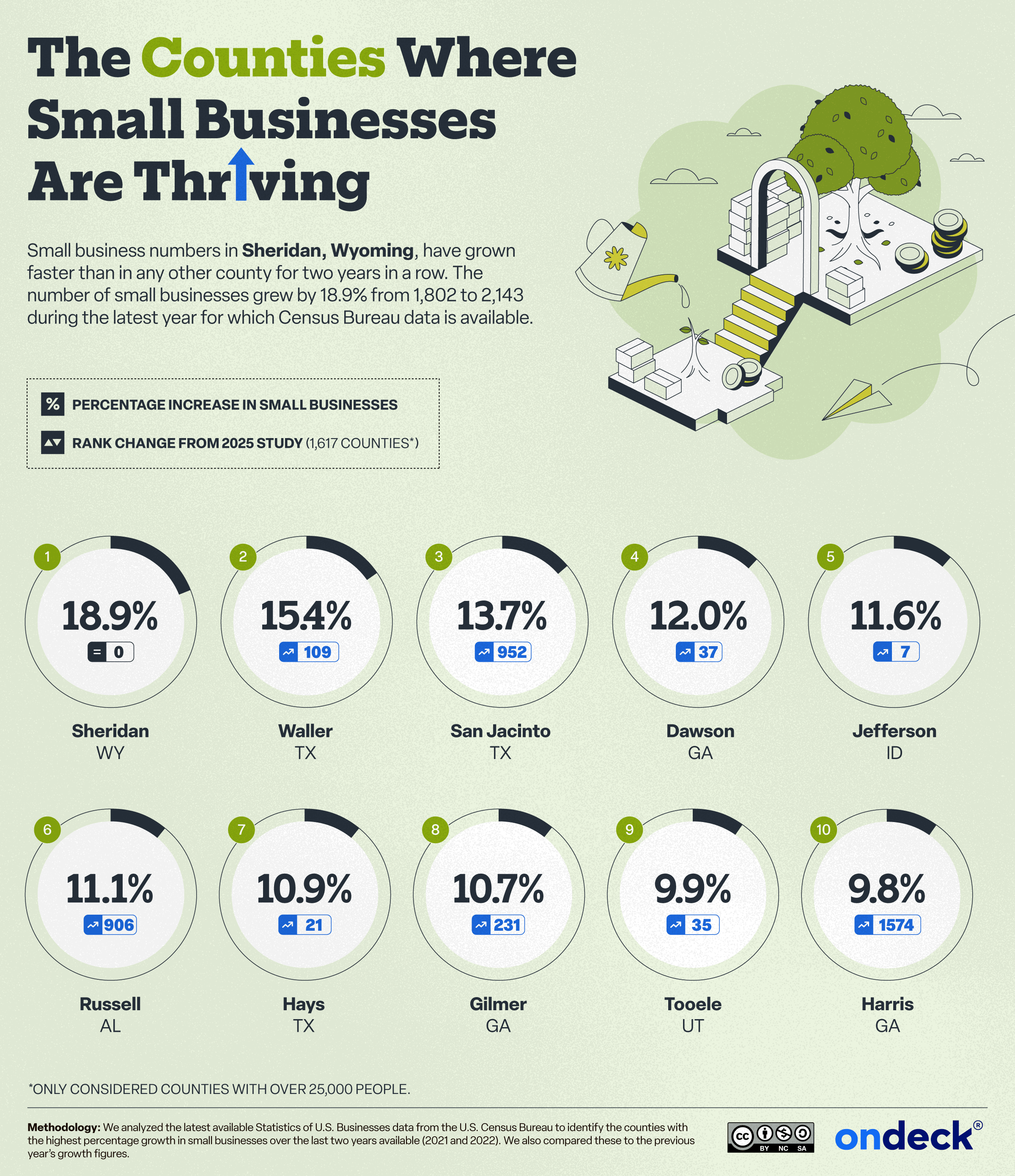
Sheridan in Wyoming remains the county with the fastest rise in small businesses for the second year in a row. The net number of small businesses here rose by 341, or 18.9%, from 1,802 to 2,143 between 2021 and 2022. There are three counties in Texas and three in Georgia among the top 10 in the U.S.
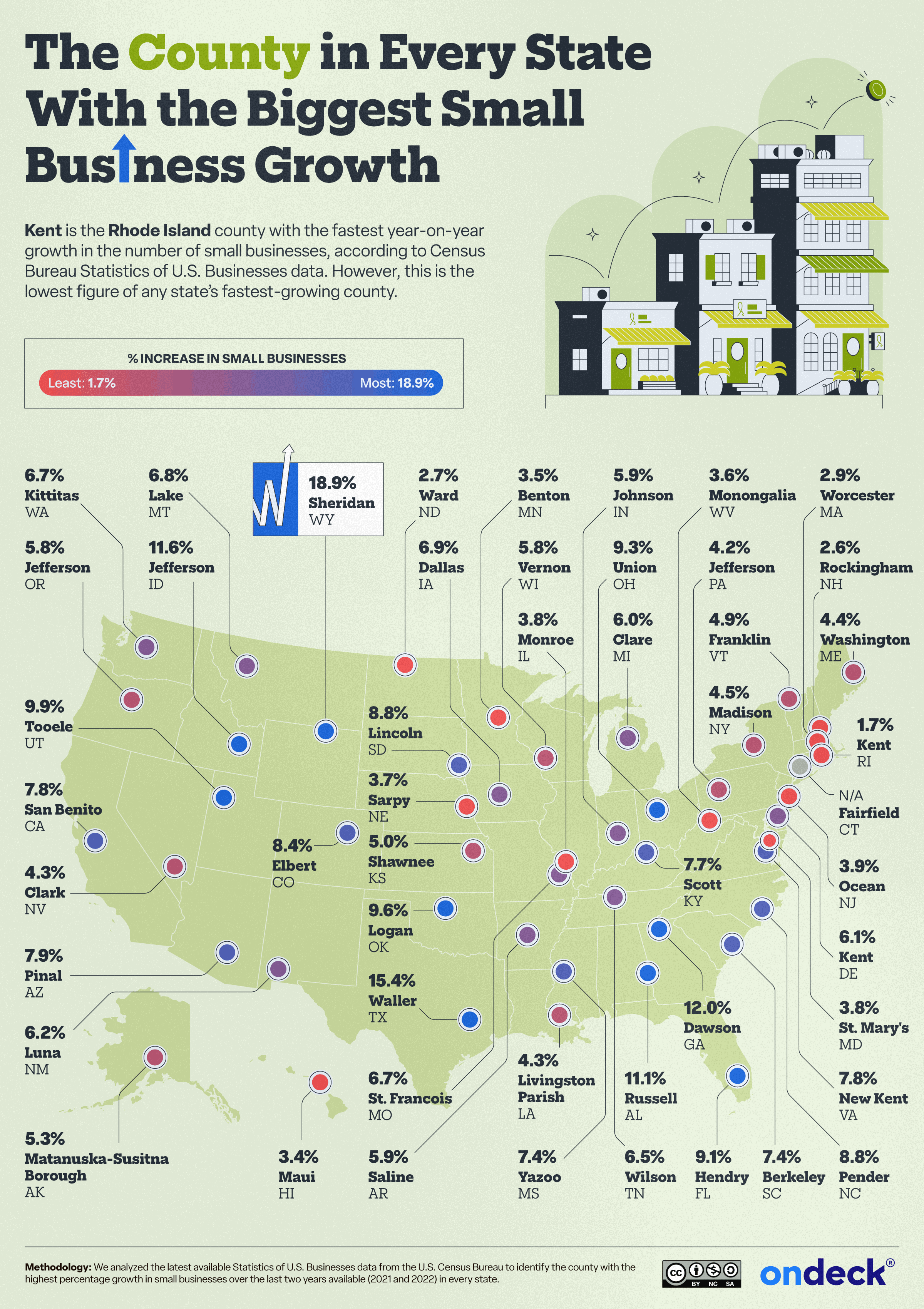
Outside of Wyoming, Waller in Texas is the county with the largest net growth in small businesses (15.4%). These two states, along with Alabama, Idaho and Georgia, are the only ones with counties that have more than a 10% increase in the number of small businesses.
Where can small businesses find funding?
Small businesses can find funding through SBA loans, traditional banks and credit unions or online lenders. The best fit depends on how fast you need the money, how strong your credit and financials are, and whether you want flexibility or a one-time lump sum.
If you want to compare options quickly, start with a broad overview of small business loans — then narrow down based on your timeline and use case.
SBA Loans
| Pros | Cons |
| Lower costs. In many cases, SBA-backed loans often come with more competitive rates than other options.
Longer repayment terms. That can mean lower monthly payments and more breathing room. Larger loan amounts may be available. Helpful for major expansions, buying a business or refinancing. |
Slow process. More documentation, more steps and longer timelines.
Stricter requirements. Strong credit, solid financials and detailed paperwork are common. It may be hard to qualify for an SBA loan with bad credit. Less flexibility. The loan structure and permitted uses can be more restrictive depending on the program. |
Banks and Credit Unions
| Pros | Cons |
| Familiar option. If you already bank there, it may be easier to start the conversation.
Potentially lower rates. Well-qualified borrowers with strong credit and collateral can receive better rates. Relationship value. A good banking relationship may be able to help over time with future financing. |
Underwriting can be strict. Banks often want strong credit, consistent revenue and clean financials.
Funding can take time. Even if you’re approved, the process may move slower than you need. Less helpful for “messy” situations. Seasonal dips, thin credit files or recent changes can make approval harder. |
Online Lenders
| Pros | Cons |
| Speed and convenience. Applications for online business loans are typically faster and more straightforward than traditional routes.
More options for different needs. You can often match the product to the purpose:
May be more flexible on underwriting. Some lenders weigh cash flow and business performance more heavily than credit alone, including options like no credit check business loans (often meaning no hard credit pull, depending on the lender).
|
Cost can be higher. Faster access and flexible approvals may come with higher rates or fees.
Terms can vary a lot by lender. You’ll want to read the details and compare total cost, not just the payment. Some products can be more aggressive. Options like merchant cash advances can be easier to access, but they may be expensive, and repayment can move with sales volume.
|
Methodology
We analyzed the latest available Statistics of U.S. Businesses data from the U.S. Census Bureau across states, metropolitan areas and counties to identify the places across America with the highest percentage growth in small businesses by comparing the last two years available (2021 and 2022). We also compared these figures against the previous year’s growth, which was obtained by the same method.
This is an independent study, and the Census Bureau is used strictly as a data source, not as an affiliate, partner or endorser of OnDeck or this content.
In this data set, a small business is defined as a company with fewer than 500 employees. This study was completed in August 2026.
DISCLAIMER: This content is for informational purposes only. OnDeck and its affiliates do not provide financial, legal, tax or accounting advice.


