
No cost. No impact to your credit.


College marketing materials often focus on their big-name alumni, including those who have gone into leadership roles at Fortune 500 companies and international brand names.
But small businesses are the engine rooms of the American economy. Companies of under 500 employees account for 99.9% of all businesses, employing 45.9% of the population, creating the majority of new jobs and generating trillions of dollars in revenue. For most budding entrepreneurs, a school that has produced a small number of celebrity bosses should be less impressive than one that demonstrably prepares students for the realities of the entrepreneurial path and the nitty-gritty of business life — whether it’s running a family business or launching a startup.
To identify America’s small business factories, online business lender OnDeck used LinkedIn data and calculated the number of small business owners per 10,000 graduates for each of the 436 top colleges in U.S. News’ National College Rankings.
What We Did
We filtered LinkedIn data to record the total number of graduates from each of the top colleges overall and the number from each college with the current title of “owner”/”co-owner” for a company of fewer than 500 employees. Combining both values enabled us to calculate the current number of small business owners per 10,000 graduates from each college.
Key Findings
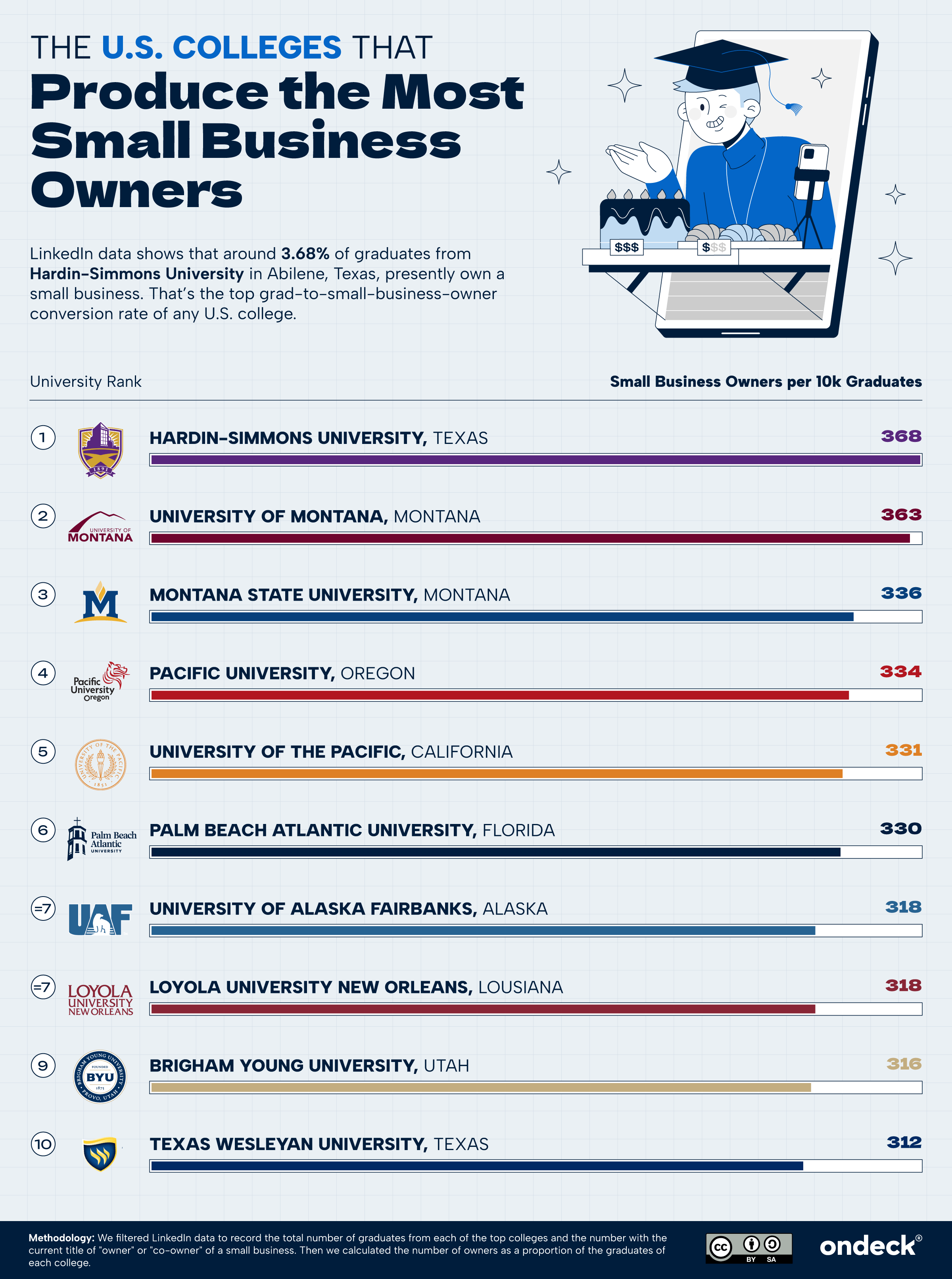
- Hardin-Simmons University in Texas is the U.S. college that produces the most small business owners — 368 per 10,000 graduates, according to LinkedIn data.
- The public college that produces the most small business owners is the University of Montana (363 per 10,000 graduates).
- California’s top college for producing small business owners is the University of the Pacific (331 per 10,000 graduates).
Multiple Texas colleges among those that create the most small business owners.
First, we identified the colleges with the most graduates who now own a small business, according to their LinkedIn profiles, before breaking it down into public and private colleges.
Of all types of colleges, the school that produces the most small business owners is Hardin-Simmons University (HSU), a private Baptist university in Abilene, West Texas. There are 11,354 self-identified HSU graduates on LinkedIn, of which 418 list themselves as an owner or co-owner of a business employing under 500 people — meaning the school produces 368 small business owners per 10,000 graduates.
Hardin-Simmons delivers business and business-related programs, including Music Business, Management and Accounting through its Kelley College of Business, but majoring in business is not a prerequisite for ownership. Psychology grad Jia Spangler minored in marketing but fell into management when given the chance to buy out the boutique where she worked as an employee.
“I have always been interested in potentially starting my own business one day, but I never thought the opportunity would come up so soon, especially right out of college,” she told her alma mater in 2024. “Connecting with people is important when running a business, and you learn so much from others… Talking to other small business owners can help, as these are challenges I think all businesses face or have faced in the past.”
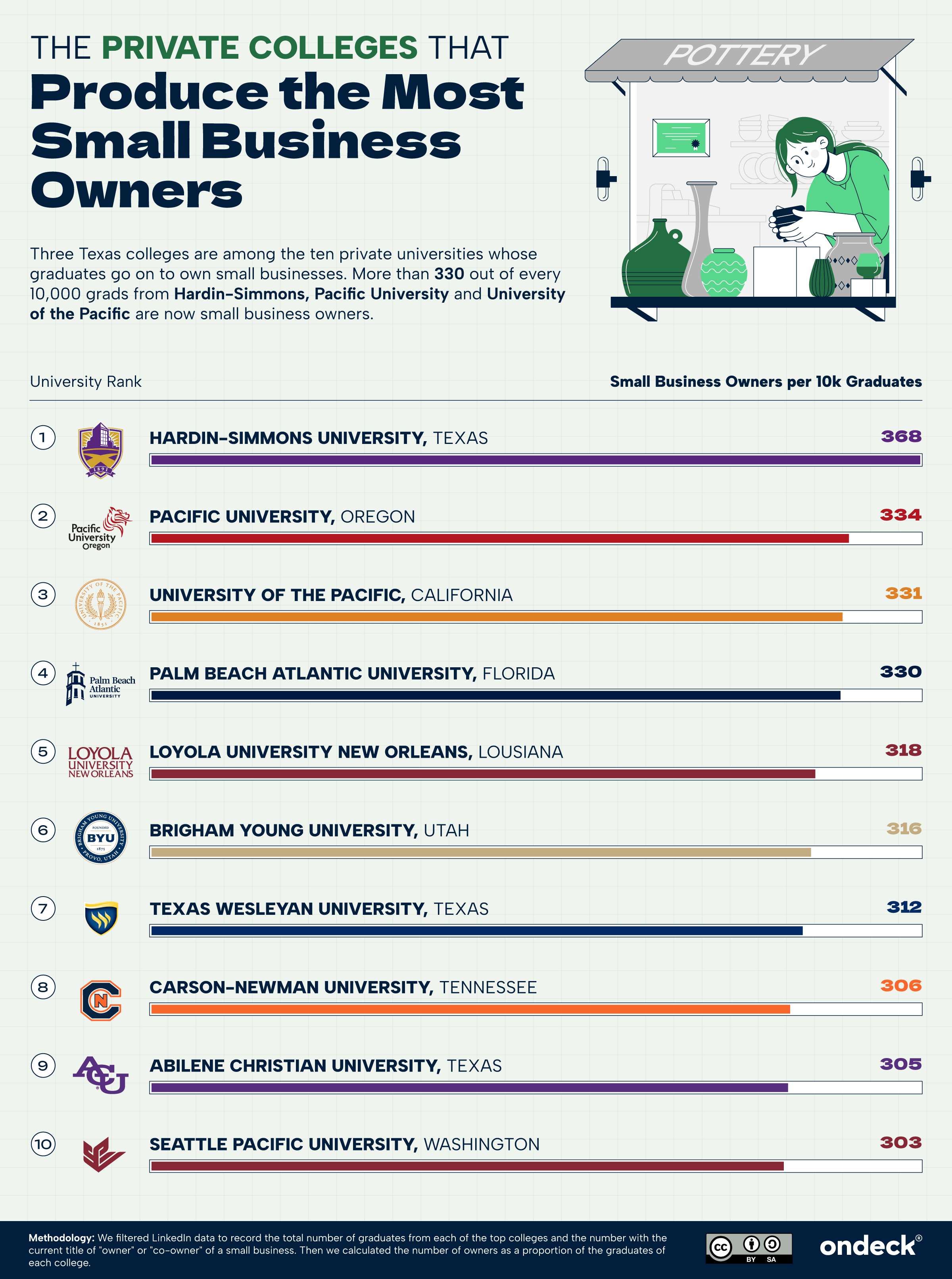
HSU is one of three Texas schools among the ten private colleges that produce the most small business owners, along with Texas Wesleyan University (312 per 10,000 graduates) and Abilene Christian University (305).
Meanwhile, the top public colleges are mainly grouped in the Rocky Mountain states, with the University of Montana (363) and Montana State University (336) occupying the top two positions. The University of Montana (UM) is recognized as having one of the best business schools in the region and reports that 94% of alumni find work or enroll in grad school within six months of graduation. The school maintains the Rural Entrepreneurship and Leadership Co-Lab and developed the Small Business Association-funded Montana Women’s Business Center, which benefits students, graduates and those without formal business training — a group that includes 63% of Native women entrepreneurs.
“Native women are natural entrepreneurs – resourceful, resilient, creative and deeply connected to our communities,” says Tonya Plummer, executive director of the Montana Native Growth Fund. “The ability to offer a WBC Native woman business adviser meets this need. The growth of successful, thriving Native women in business promises exponentially positive impact on future tribal generations.”
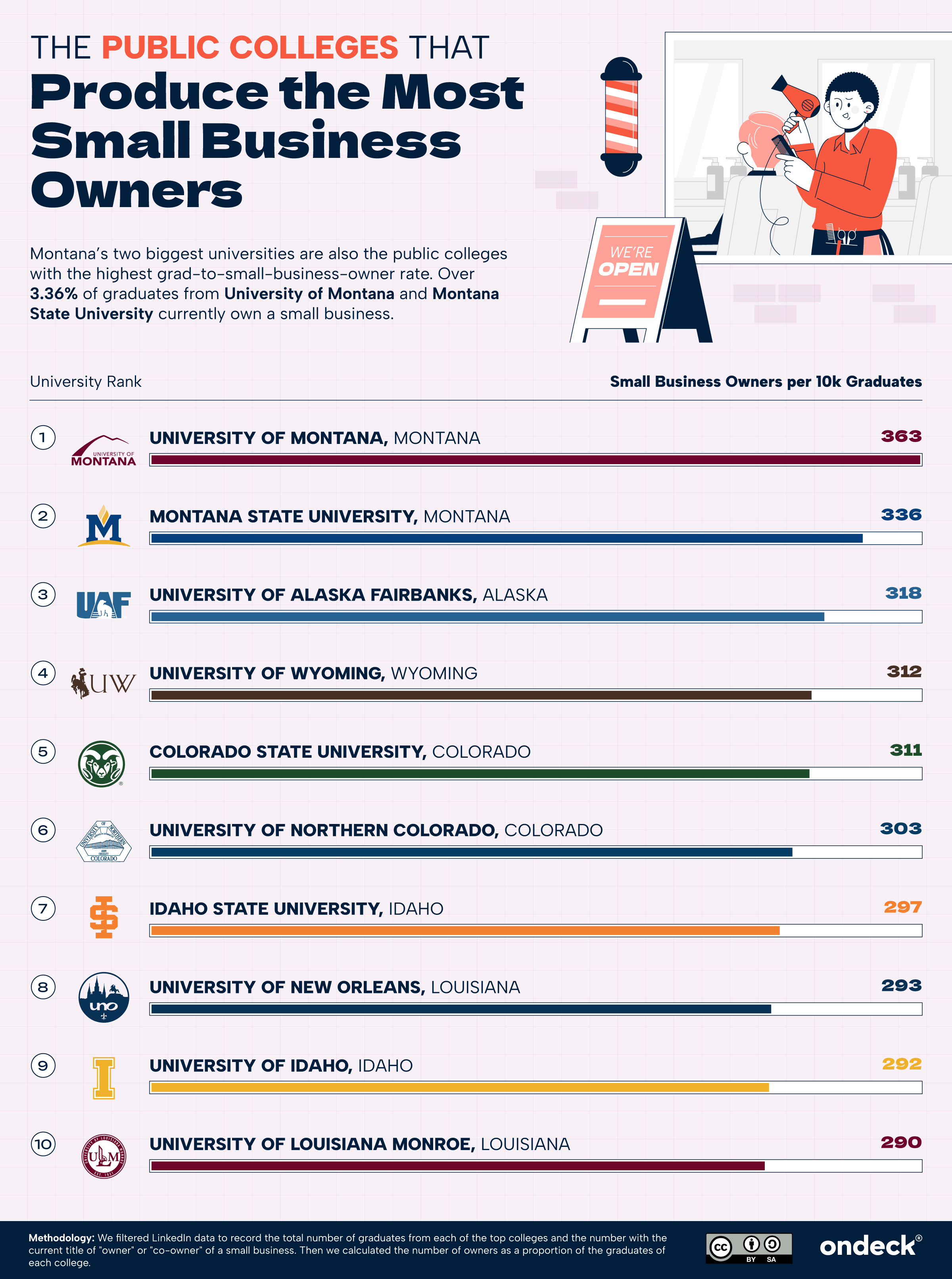
Despite a more modest business profile, Montana State University (MSU) produces the second-highest number of small business owners of any public college and the third-highest number among all U.S. colleges.
Ellie Darr graduated from MSU as a Geographic Information Systems major while working for an ice cream wholesaler. But after helping develop retail premises for the business, Darr ended up buying the shop, rebranding the business to put it literally on the lips of local ice cream aficionados. Working her way through from making the product to opening the store means Darr understands both the product and her customers.
“I’m proud of the product we make, and I’m unbelievably proud of the service that we provide with that,” she tells Yellowstone Public Radio. “Good customer service for customers is the heart of any successful business.”
Springfield College is top of the Northeast for small businesses.
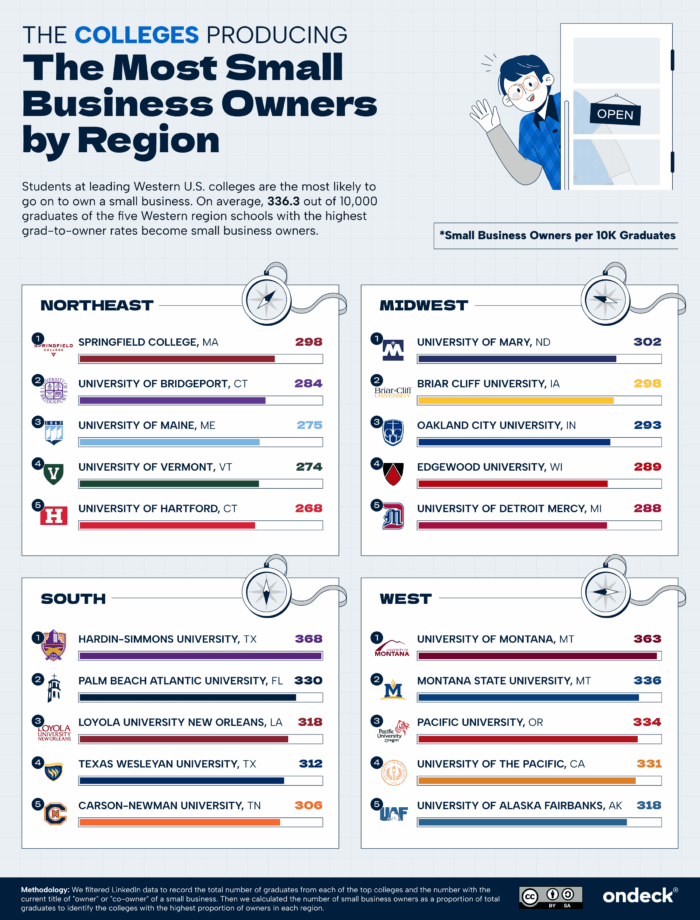
Next, we broke the data down by region and state. In the Northeast, Springfield College in Massachusetts produces the most small business owners — some 298 per 10,000 graduates, based on profiles of 31,389 Springfield graduate profiles on LinkedIn.
Springfield produced SBA Massachusetts Young Entrepreneur of the Year Jonathan Katz, who switched mid-degree to business and marketing to develop his idea for a powered portable blender bottle for the market. His professor encouraged Katz to pitch to the Grinspoon Entrepreneurship Initiative, a consortium of colleges that supports student entrepreneurship, and he won the Grinspoon Award two years in a row.
“Opportunities like the Grinspoon Award allowed students to pitch their ideas in a very supportive setting,” Katz told Springfield’s marketing team. “As a result of the Grinspoon experience, I also had the opportunity to connect with Valley Venture Mentors, and joined their mentorship program. All of this success just kept me going, and gave me confirmation to keep going. It was the framework I needed as I started to think about how to do a start-up business.”
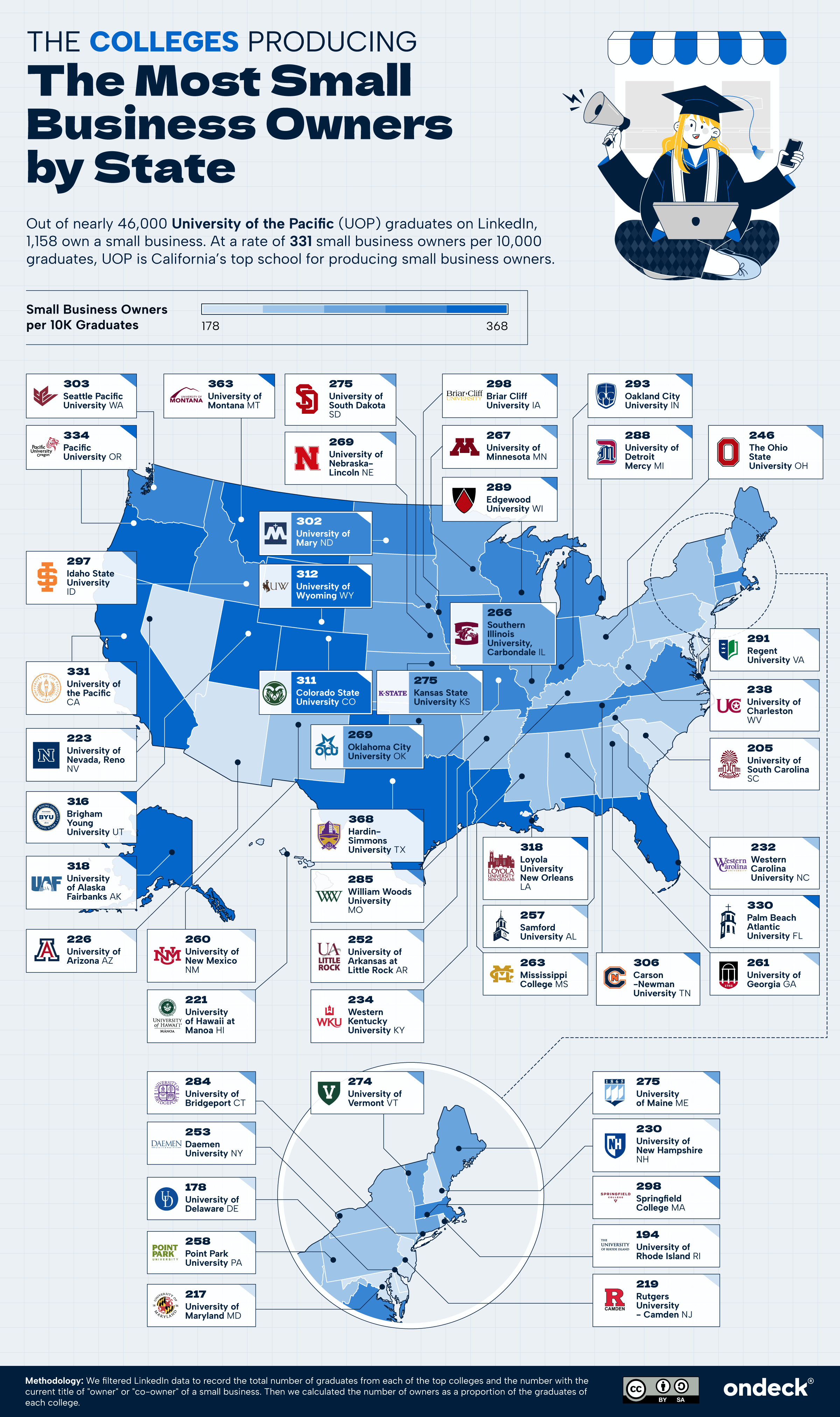
There’s a college in nearly every state that produces more than 200 small business leaders per 10,000 graduates. New York’s number one is Daemen University in Amherst, a small private college that produces 253 owners per 10,000 grads. The school is proactive in local small business endeavors, promoting alumni businesses and partnering with SCORE Buffalo Niagara and the U.S. Small Business Administration to deliver seminars and networking opportunities.
You can search and sort the grad-to-business-owner rate of over 400 top-rated U.S. colleges using the interactive table below.
What to ask yourself when deciding to go to college before starting a small business.
A good college for developing small business owners should combine rigorous business learning, networking opportunities and ongoing support. But college is not the only path into entrepreneurship — and if you do choose college, it is not essential to major in business. Here are five questions to ask yourself before making a decision about business school.
- Does your industry require formal qualifications or training? In addition to providing a deeper background on your sector, passing exams in the discipline may be legally required.
- Does the program deliver what you presently lack? Be clear about whether you’re studying for qualifications, for knowledge, for incubator support or for the network — and ensure your choice of college can deliver.
- What is your timeframe for study? If your idea is time-sensitive or you need to work long hours outside of study, consider an intensive non-degree program or a part-time degree.
- Is it the best use of your capital? Whether using savings, capital from your business or taking out a loan, college is an investment — and should be balanced against your business needs as such.
- Do you want to study? If your heart is not in it, formal study may not be the best style of learning for you. On the other hand, college can be one of life’s rich experiences: if you desire to study, it may be better to do it now than regret the missed opportunity later.
Methodology
We used LinkedIn data to calculate the number of small business owners per 10,000 graduates for each of the 436 top colleges in US News’ National College Rankings.
First, we used LinkedIn filters to record the total number of graduates from each college overall and the number from each college with the current title of “owner” or “co-owner” of a company of fewer than 500 employees (the Small Business Administration’s general definition of a small business).
Combining both values allowed us to calculate the current number of small business owners per 10,000 graduates from each college.
Data is correct as of December 2025.
DISCLAIMER: This content is for informational purposes only. OnDeck and its affiliates do not provide financial, legal, tax or accounting advice.


